Sultan Erdogan’s Libya conquest

Anna van Densky OPINION The considerable efforts of the European diplomacy to resolve the ongoing conflict in Libya ended up in an unpleasant revelation of the successful colonisation of the oil-rich country by Sultan Erdogan, who has found in Fayez Al-Sarraj (pictured) – the head of the Tripoli administration, – utmost loyal vassal, who effectively misuses his international mandate to empower Ankara.

The Memoranda of Understanding (MoU) between Tripoli administration and Turkish government appeared as a fuit of devotion of Al-Sarraj to “his people”, re-constructing the Ottoman Empire and enriching them with Libyan natural wealth.

Although being from Tripoli, Sarraj was born to a prosperous Turkish family of merchants, and landowners. His father Mostafa Al-Sarraj served as a minister to Libyan Monarchy. Certified architect, Al-Fayez continued family tradition, leading Housing Ministry under Gaddafi régime. However his appearance at international area is associated with the Skhirat Agreement, upgrading his status to the chairmanship of the reconciliation government. Apparently the position he used extensively to promote dear to him Turkish interest in Libya and the Mediterranean.

The EU blind trust in Government of National Accord (GNA) as the only recognised executive power in Libya, opened unlimited number of possibilities to Al-Sarraj to serve his remote patrons in Ankara, including Muslim Brotherhood, which is often falsely accused of keeping him hostage. No they are not – Al Sarraj is not their hostage but adept!

The MoU is not just a document, but a strategic choice, and political declaration of loyalty, replacing Gaddfi dictatorship era with perspective for Libyans to become a colony of Ottoman Empire, and all that in the context of full passiveness of the EU, which is surrendering to Erdogan, at all fronts, pretending Turkey is still the EU candidate country, willing to pursue the way of reform towards European integration.

The MoU is also a crossed red line, the abuse of office by Al-Sarraj, who has been given international support and mandate to gain confidence of Libyan people to establish lasting peace, but not to seal shady deals with foreign powers,

Considering the abuse, it is time for the EU to assess the status of Tripoli administration objectively – it is unconstitutional, because its mandate has been issued by Skhirat agreement (17 December 2015) for one year, with a possibility for renewal for one year only, on condition of the Parliament approval, which has expired a long time ago. And now the EU has to deal with the illegal administration promoting Turkish colonisation of Libya. How moreabsurd European diplomacy can go?

The Minister of Foreign Affairs of the Interim Government of Libya AbdulHadi Lahweej statement as read by the Chaiman of the European Parliament delegation to the Meditarranean MEP Costas MAVRIDES on 18 December 2019 in Strasbourg:

“First of all, I would like to thank you for inviting me to attend this important i meeting in beautiful city of Strasbourg, I would like to inform you that I was unable to come due to cancelation of flights and the pressure on Benina Benghazi Airport, because of attacks on our airport by Al-Sarrajs Militia who they destroyed the planes and now we only have one plane which was hijacked by Misurat city

“The Turkish incursion into the countries of the region in general and in the Mediterranean basin specially basin has now become clear to the general public after signing with the unconstitutional of Al-Wefaq government two memoranda of understanding:

the first one on demarcation of maritime borders،
and the second memo on security and military cooperation

These two agreements are rejected by the Libyan parliament and the interim government in addition to National Libyan Army , we reject these memoranda of understanding،: for several reasons، the most important are legal reasons:

“Al-Wefaq government is unconstitutional،, which did not gain confidence from the Libyan parliament،, and rulings were issued against it by the Libyan courts that invalidated all decisions issued by them.
According to the Skhirat Agreement, which did not guarantee who else is also for the constitutional declaration, the first article / fourth paragraph states that the mandate of the reconciliation government is for one year only since it was given confidence by the Libyan parliament and renewed automatically for one year only, therefore the mandate of the reconciliation government has expired For a long time ago, this government can no longer conclude any treaties and agreements that bear any international obligations on Libya
The Memorandum of Understanding violates the Law of the Sea signed in Jamaica in 1982 between two countries that do not have common borders and, more seriously, threatens our friendly relations between neighboring countries of Libya (Greece, Cyprus, and Egypt)
Accordingly, the two memoranda of understanding are canceled and have not entered Into effect. In view of one of its parties, Libya has not completed its required legal
procedures.”

Farewell to Juncker era

Anna van Densky OPINION President of the European Commission Jean-Claude Juncker concluded his mandate in his unique ‘cool‘ style in an informal PR event, with a lot of applause and a few mediocre questions from Brussels press corps, which is definitely not his fault.

I have always said that me and euro are the only survivors of the Maastricht Treaty, but after my departure only euro (currency) will stay, Juncker said with a good dose of humour in exchange with journalists. “I am happy to leave the “most difficult job in the world””, he confessed , mentioning successes and regrets, he did not specify.

From the behalf of the Brussels International Press Association (API-IPA) Italian ANSA correspondent read a short thank you speech, without any assessment of the Juncker Commission achievements, explaining there would be a broad divergence of opinions on the subject.

However there was a sadness in the air from saying good-bye to a generation of European politicians – the dreamers of a grand project of the United States of Europe, conceived by Robert Schuman and Jean Monnet, the believers in European Union as a family of nations. Looking back on five years of Juncker Commission, one can recognise his attempt to create an informal atmosphere of friendliness, togetherness, and genuine multiculutralism in spite of multiple systemic crises, eroding the EU project.

Juncker era is definitely over…

His heiress, German Ursula von der Leyen has already imosed the style of her upcoming mandate, taking the decision to stay in Berlaymont building at all times, using permanently the adjacent 25 square meter appartement designed as “personal retreat” in the same building on the 13th floor.

Her main residence remains in Hannover, Germany, where her husband lives and works. Does she expect everyone to follow, introducing Japanese sleeping at work place culture INEMURI in European Commission, when in absence of adjacent appartements the European civil servants will spend long hours in offices, falling asleep at their tables?

However this von der Leyen decision has further reaching consequences, ending the story of Brussels as modern “melting pot”, and reducing it to headquaters of EU management, shaped by staunchly tribalism – after the intense week of work inemuri style, everyone will return to the relevant national communities. Good-bye, Brussels Babylon tower dream…

Nomandy Four: «winners and losers»

Anna van Densky OPINION Kremlin spokesperson Dmitry Peskov said it is inappropriate to assess the outcome of the Normandy Four Summit in Paris in terms of the “winners and losers“.

“Everyone pursued the same objective, that is, to resume the work of the Normandy format after a long break and revive real efforts to find a solution to the conflict in southeastern Ukraine” he explained.

Certain steps, important steps in that direction have been taken, but much more remains to be done,” Peskov underlined.

It is inappropriate to say here who was the winner and who was the loser at that Summit,” Peskov concluded.

However Peskov is wrong, because not everyone pursues the “same objective“, and the Normandy Summit projects on the broader political context, where there are “winners and losers” in the protracted Donbass conflict, and their numbers multiply each single day.

Zelensky presidency and Kiev government to deal directly with people of Donbass, whom they formally consider their citizens, but the same time also “separatists” or “occupants“, creates a toxic atmosphere, affecting all spheres of life, including investment climate. However it is mass migration that damages Ukraine the most, forcing the active and skilled population to flee instability, and search for jobs outside the country. During last five years of Poroshneko mandate the figures of departures mounted up to 100 000 people a year. Will Zelensky be able to renverse the trend?

When electing Zelensky, the voters massively rejected the belligerent politics of his predecessor Petro Poroshenko, who ascended power by the violence coup d’état, and launched offensive against the Russian-speaking est of the country, calling the operation a “counter-terrorist” raid. The Ukrainian electorate expects from Zelensky the Donbass conflict resolution without delay. In many cases falsely presented as a conflict between Ukrainian pro-Europeans and pro-Putinites, it is about the respect of the fundamental rights of minorities in Ukraine.

“After Viktor Youchenko attributed a statuts of hero of Ukraine (2010) to Nazi criminal and Holocaust ideologist and active participant Stepan Bandera, the assimilation firmly replaced the respect of minority rights.

If later Petro Poroshenko initiated the inclusion in the Constitution of Ukraine the clause on EU integration, the claim stayed totally nominal, while the EU has 60 regional languages, Kiev marched the opposite direction. The European Union was established as a project of peace, while Ukraine decides arguments with artillery.

Suffocated by chauvinism and corruption, the Ukrainian society is in perpetual conflict with all the national minorities who are denied of the elementary individual and linguistic rights.

The slow motion for the implementation of Minks agreements, also projects on the degradation of relations between the ethnic communities within the Ukrainian society, while they realise that reluctance of Kiev to grant Donbass a special status means a denial of their identity as well. Meanwhile the notorious language law, voted by Rada and endorsed by President Porkoshenko causes concerns of the Venice Commission, making a conclusion that it strips ethnic minorities of use of their mother tongue, violating their fundamental rights.

“The language law, breaching international laws and commitments of Ukraine, is a bad omen for Donbass people, and all the other minorities in the country, but it would be naïve to think that it does not rub off the credibility of Zelensky. Silently agreeing to serve as a blunt instrument of the West to deter Russia, through repressing Russian minority in Donbass, he is undermining his own leadership in eyes of around hundred other minorities living on the territory of modern Ukraine.

While the West is cheering Zelensky, encouraging him to oppose President Putin in a Cold War syndrome style, refusing fundamental rights to Russian ethnic group in Donbass, the entire complex of minority rights in Ukraine are sacrificed, overlooked as collaterals in the crusade against Kremlin. However, hostage to Ukrainian radial nationalists with their agenda of total “Ukrainisation” of population, Zelensky‘s target of “de-occupation” of Donbass creates a self-destructive narrative, betraying his own electorate demanding peace, and surrendering further grounds to nationalists, hailing Bandera, the true winners of protracted Donbass conflict.

Paris to host Ukraine Summit

The Presidency of France announced Ukraine Summit in December in Paris with participation of both Presidents – Russia’s Vladimir Putin and Ukraine’s Volodymyr Zelensky on December, 9.

Ukraine Foreign Minister Vadym Prystaiko said that all conditions for the meeting of the Normandy four were fulfilled, and the date of the summit is now being agreed upon.

German Chancellor Angela Merkel confirmed her participation in the Ukraine Summit of the Normandy Four countries on December 9 in Paris.

Brexit extension “flex”

The length of Brexit extension is a priority subject in the EU, considering how long should be a new timetable for the UK departure from the bloc.

There are three major suggestions in the air: three months, six months and one year, the last one is propelled by those who hope for the second referendum and derailing Brexit as such.

However Brexit Party leader and Member of the European Parliament Nigel Farage insists on six month extension, explaining that winter months are interrupted by holidays, and six month extension give sufficient time to organise general elections – the only way out of parliamentary Brexit crisis.

Foreign minister of the Republic of Ireland Simon Coveney said that Britain will be offered a flexible extension that could trigger Brexit well ahead of the new deadline but that the opinions of all EU member states were first needed.

“I think that extension will be a flexible one, that will allow the United Kingdom to leave the EU – if they can get a deal done – well in advance of the end of that extension period which looks like it will be the end of January,” Simon Coveney told an audience in Belfast on Wednesday.

Brexit Deal II fate in hands of Westminster

While British Prime Minister Boris Johnson and European Commission president Jean–Claude Juncker consider the agreed Brexit deal “fair” outcome. There is no need to extend the Brexit deadline EU top executive added.

‘We have a deal so why should we have a prolongation?” Juncker raised a rhetoric question. However the biggest challenge is ahead in Westminster, where the the Democratic Unionist Party (DUP) of Northern Ireland declared its opposition to the reached Article 50 Agreement.

Prime Minister Johnson called Members of the Parliament to “come together” and “get this excellent deal over the line”.

Now is the moment for us to get Brexit done and then together work on building our future partnership, which I think can be incredibly positive both for the UK and for the EU” he underlined.

In spite of the enthusiasm of the EU leadership about the new deal, the experts consider the chances it is endorsed by Westminster on Saturday are slim because of opposition of Labor and DUP parties, who consider the deal to be even worse than Prime Minister May previous Agreement.

Jutta URPILAINEN: EU future Santa-Claus?

Undoubtedly Jutta URPILAINEN is exceptionally kind, generous and honest, and above it all sensitive to other people’s grievances. Mother of two adopted Colombian children, she is certainly an exceptional human-being. However are they the qualities to carry on the job of the EU Commissioner on International Partnerships? (Previously International Cooperation and Development led by Croatian Neven Mimica #DEVCO).

During the October 1 hearing with Members of the European Parliament (MEPs), Urpilainen has successfully avoided all the burning problems of Africa – the major recipient of the EU development funds: CORRUPTION, TERRORISM, ETHNIC CONFLICTS, CHINA EXPANSION, DEMOGRAPHIC EXPLOSION, – none of them were addressed. Even Ebola!

The entire debate she stayed in shallow waters of wooden language of the EU politically correct: important ‘‘improvement”, “empowerment”, “transparency”, “equality”, “listen to people”, and the other “meaningful” cliches, favored by the EU Mandarines, dramatically lacking vision and imagination.

From time to time she was making a nod to MEPs, flattering them with reminding of her “unelected” status vis-à-vis their elected superiority. However these calculated maneuvers could not take away an impression of a dramatic lack of knowledge of the development portfolio.

At most ambivalent impression made Urpilainen  “asymmetric” answers to MEPs questions, clearly prepared in advance, and used without adaptation.

Finally, she promised to “learn”,  “listen”, and to “improve“, however the question remains if the EU needs an “apprentice-Commissioner”?

CONCLUSION: One can’t become pilot over night taking off plane w/ 300 passengers over Atlantic, but one can become aid Commissioner with  €20 000 a  month salary without a clue of international politics. What a soap!

October 1, European Parliament, Brussels Jutta URPILAINEN for International Partnerships Commissioner.

img_7894

Brexit paradoxes continue

Anna van Densky OPINION Next week the European Parliament starts the series of hearings to endorse the team of Ursula von der Leyen Commissioners-designate. In one of paradoxes of protracted Brexit the British Members of the European Parliament (MEPs) will participate and vote for the candidates, influencing the EU politics in spite of the fact that they did not propose a Commissioner themselves for apparent reasons.

Roughly 10% of votes, 73 UK departing MEPs will influence decisions shaping future composition of the top executives of the Commission – the guardian of EU Treaties, and the initiator of new laws.

However it is not the end of the road. In case there will be one more extension of Brexit beyond October 31, British government has to appoint a Commissioner to Brussels. Will Lord Hill come back? (Joke). Will Sir Julian King stay? If ‘yes’, it will be to the greatest joy of the Remainers,  assessing his marriage to the top EU civil servant Dane Lotte Knudsen (Germany, EEAS) as an ultimate sign of this loyalty to Brussels. Conflict of interests? One can hardly blame it to any UK national amid total confusion the protracted Brexit is causing. (Continuation follows),

Dutch Fauna party leads largest Europarl Intergroup

In the framework of the September Strasbourg Plenary the Animal welfare Intergroup of the European Parliament has elected Anja Hazecamp, Dutch MEP as president of the biggest cross party congregation.

Anja Hazekamp (51) is a prominent Dutch politician, a member of the Party for Animals (PvdD), and a member of the group of the European United Left – Nordic Green Left (@GUENGL).

The PvdD is the first political party across the  world to gain parliamentary seats, including three seats for Senate, with an agenda focused primarily on animal rights, and animal welfare. At her election Hazekamp said she expects from Ursula von der Leyen ‘real change” in animal welfare issues.

Hazekamp was elected unanimously as the only candidate put forward by the MEPs. The former president of the group Sirpa Petikainen has been elected as an Honorary president.

The Intergroup is providing a forum for debate, and initiating actions for animal welfare-related issues in the European Parliament.  An entire spectrum of activities as issuing  reports, resolutions or amendments, formally asking parliamentary questions and sending letters to authorities, organising public awareness events, – all of them resulted in graduate improvements in the animal welfare situation in the EU.

 Next meeting of the Intergroup will take place in Strasbourg during October Plenary to discuss problems of exotic pet trade in the EU (Thursday 24 October, 10:00 – 11:00).

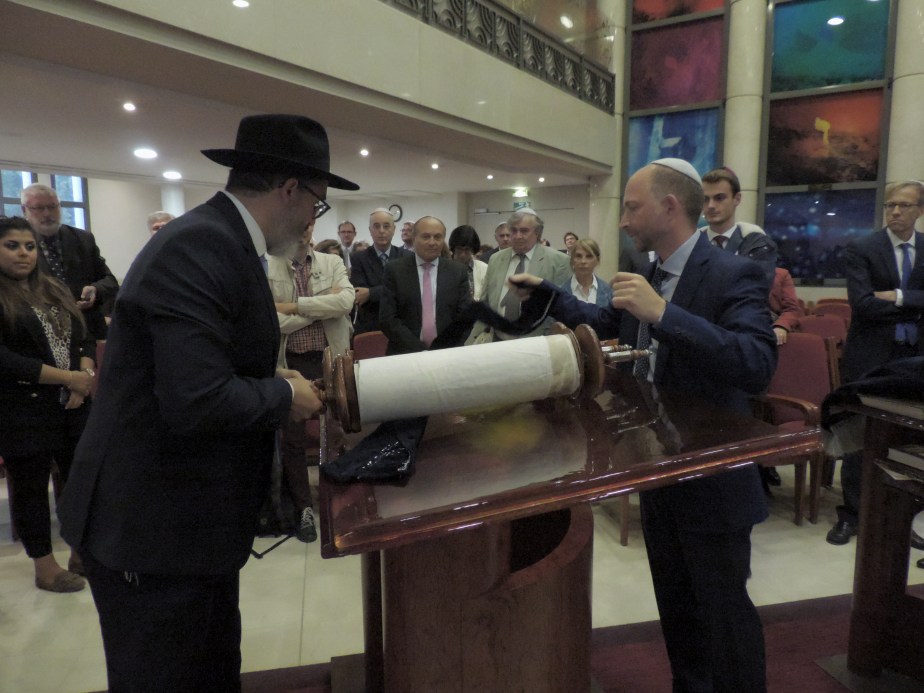
Memorial to Strasbourg Grand Synagogue

Modern IT technologies will help to give a second life to a destroyed by Nazi Grand Synagogue, this time in a form of a bronze monument, established at the original place at Quai Kléber. The Jewish community, IT scientists, historians, and lovers of history have  collected a significant amount of information, allowing to restore the exact model of the demolished building.

DSCN9824[1]
IT reconstruction model of Grand Synagogue Quai Kléber
On 18th of September, during the European Parliament Plenary week the Jewish Consistory of Bas-Rhin invited to the Synagogue of Peace  Members of the European Parliament (MEPs) and Strasbourg politicians to celebrate in a cultural event the upcoming Rosh Hashana (New Year) festivities. The excursion in the building of New Synagogue preceded the assembly.

DSCN9833[1]
Rabbin Mendel Samama (right) and Thierry Roos of Consistoire israélite du Bas-Rhin (left)
The collection of the artefacts and historic objects exposed as precious pieces of mosaic restore the picture of the spiritual past of the  Jewish Community in Alsace  – one of the most ancient in Europe, traced to the Middle Ages.

DSCN9826[1]
Grand Synagogue de la Paix historic objects collection on display

After the World War II  the Jews who survived the Holocaust, reformed the Jewish community of Strasbourg, meeting in the Holiday Palace until 1948, because the Grand Synagogue, situated at Place Klèber was destroyed.

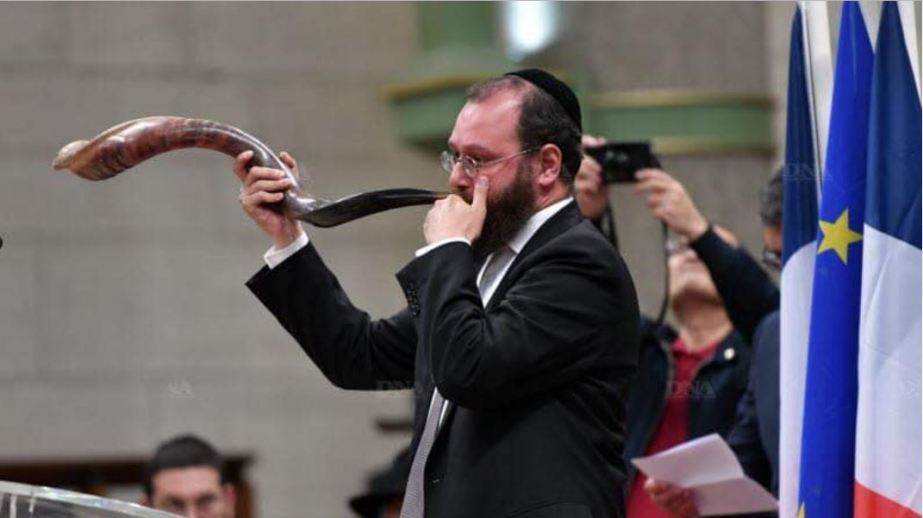
Levi horn
Rosh Hashana sound of Shoffar Image: courtesy of Levi Matusof (pictured).

Following the talks with the city of Strasbourg in 1948, the Jewish community agreed to exchange the grounds of the old Synagogue against the site of Contades area, where the new monumental building was erected, by the  architect Claude Meyer-Lévy. The synagogue, called “Peace” replicating its location Rue de la Paix,, and was inaugurated in March 1958.

DSCN9834[1]

The new synagogue also includes the Judaica radio headquarters, a youth center, and the headquarters of several movements, in addition to the four oratories.