Moscow reacts with reserve on Washington sanctions

The signing of a law on tougher US sanctions against Russia, North Korea and Iran by President Trump does not change anything de facto in the current situation, the Russian President’s press secretary, Dmitry Peskov said, according to Russian TASS news agency.

“The very fact of signing the law doesn’t change anything,” he said when a reporter asked him about the impact of the sanctions and a possibility of retaliation from Russia.

“What kind of measures?” Peskov went on. “No new steps. Retaliatory measures have already been taken.”


EU-Russia talk – falling on deaf ears

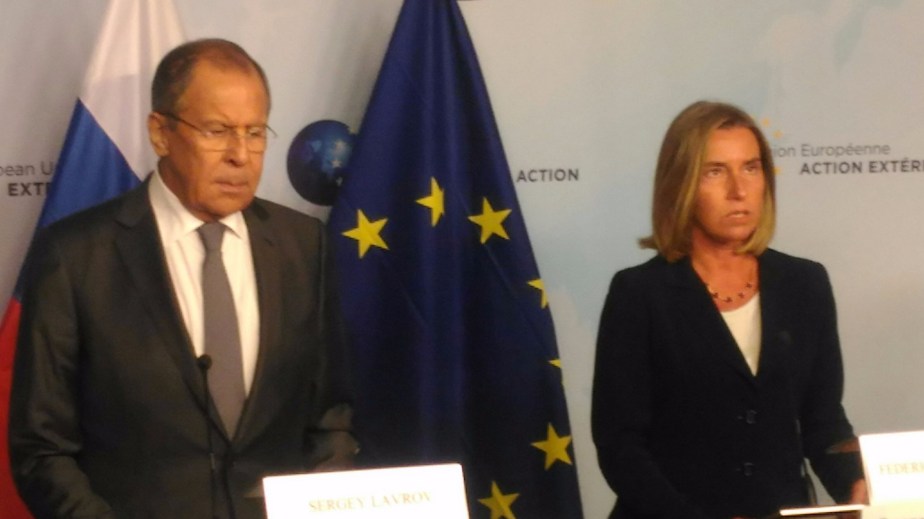
The consultations between Russian foreign minister Sergey Lavrov and EU top diplomat Federica Mogherini were very brief, and hardly resembled the ostentatious format of the strategic partnership, practiced between the EU and Russian in the recent past, before the Maidan revolution in Ukraine. Lavrov did not make a secret of the EU meeting taking place as an addition to his visit to Belgium, however he agreed to accept the invitation, and thanked for it, considering exchange as useful.

However even at a glance at two gloomy and tense officials one could assess the talks as a formal exercise, where none of the parties expected a rapprochement. The long list of issues from the international agenda, cited by Mogherini, just made one think how little left in common between two neighbours, sharing the responsibility for the security and stability of the European continent.

Although Lavrov expressed confidence in returning of the EU-Russia relations to  its ‘normal course’, it is difficult to imagine how this normalisation is possible with the incumbent EU leadership’ hostility towards Kremlin. The comparison of Russian press to Islamic state propaganda in a resolution of the European Parliament marks the lowest of the relations since collapse of the USSR. But high tight is possible: fragile after the departure of the second net contributor in two years time, the EU after Brexit will have no reserves to continue its ‘crusade’ against Kremlin. “Money is a nerve of war’.

Cornered by the US request to contribute to NATO according to the engagement, and cut off the UK fee to the European purse, the EU27 will be pushed to reconsider its strategy towards Moscow unable to maintain the current level of hostility for purely economic reasons. Moreover in the end of the day the heavily  indebted Ukraine does not have the required features to remain an Appel of Discord for long – political instability and endemic corruption make it an unsuitable  partner for the EU, and unreliable client of Siberian gas for Russians. But coming on terms with realities of life is not an easy exercise for the ambitious Brussels bureaucrats, subsequently at the moment Lavrov’s reasoning falls on deaf ears.


Tillerson’s voyage to Moscow

Tillerson Moscow

Anna van Densky OPINION

It does not make much sense to discuss the possible outcome of Secretary of State Rex Tillerson’s (pictured)  first visit to Moscow, because the new US administration was not given an opportunity to work out their political strategy, or even modify the concept of the Obama’s administration. From the moment of the inauguration the inner political struggle took all the energy and resource, hardly leaving an opportunity to bring to live any of campaign foreign policy promises,  including the alliance with Russia against international terrorism.

While eager to play the doves of peace, the Democrats intentionally pushed the Republicans into the role of demons of war. The first visit of #Hillary to Moscow with a ‘reset button’ was a sheer public relations operation, however it worked on global popularity of Obama’s administration, profiling him on long-term as Nobel peace prize winner. On contrary the faux pas of the missile offensive in Syria shapes the image of Trump as a hawk, representing the unpredictable punitive forces with tyrannic inclinations, ignoring the international laws. Rex Tillerson’s mission is defined and shaped by this spontaneous US offensive in Syria.

However the US military action in Syria by no means is a result of a profound political thought, neither a beginning of a new strategy, but a haphazard tactical move to distract attention from #russianconnectons scandal during  the initial period of Trump’s presidency.

It seems that in the eyes of President Trump’s advises the offensive in Syria is about a creation of a backdrop to spoil the game of the Democrats, an answer to #russianconnections allegations. The allegations intensely undermining president’s Trump image in an attempt of the Democrats to win majority in the Congress in the future.

Tillerson’s call to Russians to abandon president Assad is largely a rhetoric exercise for a number of reasons, not the least an absence of an alternative – there is no opposition figure in Syria able to take the responsibilities, and enhance the reconciliation process.

The talks about dismissing Assad in military action in ‘regime change’ favorite US concept are even more surrealistic after the assassination of Libya’s leader colonel Gaddafi, whose death marked a beginning of an ongoing turmoil, transferring the entire country in a huge playground of jihadists.  Afghanistan, Iraq, Libya – the US foreign policy has demonstrated an out of ordinary capacity to destroy, but not reconstruct. Subsequently in Kremlin there is an understanding of that ‘creative capacity’ of the US, and certainly there is no slightest desire to give up a secular ally as Assad, who was educated in London, to one of the so-called ‘moderate opposition’ bearded fanatics.

The decision of Kremlin to decline the meeting between Putin and Tillerson indicates the initial pessimistic modality of the talks in Russian foreign ministry, because in first place there is no political agenda or strategy. Today State Department activity is a hostage of the warfare the Democrats declared to the Republican president, rejecting to accept his power and the choice of American people.

Without any new doctrine, scattered in tactical moves the US administration is chosing for spectacular actions and loud declarations to disguise its huge problems at home. No one expects any results from Tillerson-Lavrov (illustration) talks: Russians will not bow to the US to retreat from the Middle East, leaving Assad to the  wolves and Americans, stuck with home politics problems, will continue to use tactic of distracting of public attention from its interior weakness and failures by the belligerent rhetoric and operations, flexing steroid muscles of the military-industrial complex, – the true master of the game behind the scenes.

Dulce bellum inexpertis! *

(* War seems lovely to unexperienced, Latin)

PUBLISHED in @EuropeDiplomatic

Syria: Trump starring Machiavelli

Trump US Syria

The President Trump’ missile strikes on Syria amid #RussianConnections investigation give a déjà vue feeling reminiscent of Bill Clinton’ bombing of Iraq amid #MonicaGate. The initiative of a crusade for alleged chemical weapons used by president Assad reminded many,  including UN diplomat is, the bulb with white powder, demonstrated by gen.Powell before US invasion in Iraq.  Trump’s missile strike evoked so many memories…

It is hard to belive the US President was so touched by the dead babies in Syria, as some suggest,  to order a strike in an emotional move. Just couple of weeks ago (17.03.2017) he let pass unnoticed the assassination of 300  civilians in residential area of Mosul. There were certainly babies among the Iraqi victims too, but it was qualified as an ‘an unintentional accident of war’ without any consequences for the perpetrators.

Nobody was indignant about these casualties, the slain were not honored by Ambassador Haley demonstrative grief and indignation at UN emergency meeting, and there was no urgent meeting as such. The information in the beginning came to public attention  through non-American media sources, while  the US representatives were trying to find excuses for the  massive loss of human live, ‘further investigating’ and ‘learning lesson’.

In case of late US missile strike on Syria is became clear that is was planned sometime before the alleged chemical incident reported by  human rights NGOs used by the administration in bona fide, and merely as a pretext to intervene. Why ?

The first explanation is on the surface: it allows to distract attention from ongoing #RussianConnections investigation fuelled by the Democrats. Startled to discover the President is acting towards Assad in the same lines as Hillary Clinton suggested, the opponents have to put their criticism of Trump’s foreign policy on a halt, finding themselves in confusion over the U-turn strategy of the Commander-in-Chief.

Even more so the Democrates were puzzled with stakes in prism of policy towards Russia – just a week before Rex Tillerson visit to Moscow, – the missile attack on Syria, a Russian ally, transforms the US Foreign Secretary in a powerful foe, entering Moscow in the context close to the dark times of Cold War. Although there is some feeling that the Americans were sure, that president Putin would not clash with them over a remote airbase in Syria.

Awkwardly the ‘imperialistic’ ambition of Trump’s administration would help a great deal to President’s Putin re-election (endorsement) for the fourth term, uniting the nation in face of ‘American threat’, convincing a regular Russian in need of a ‘strong man’ at a steering wheel in turbulent times.

Altogether with one strike President Trump hit many goals: distracting attention of his opponents at home, pleasing his electorate with an image of a powerful and fearless world leader, protecting world order and going back to blacks of international politics making some of the European leaders delighted by clashes with Kremlin, and later paradoxically not so discontent, how it might look at first glance, benefiting from US unlawful military action in domestic political discourse. The revival of the US ‘imperialistic ambitions’ will help Putin in re-elections (endorsement) of his fourth term by regular Russians, convincing them he is a ‘strong man’ they need to withstand the predator’s instinct of ‘American imperialism.’

Machiavelli style of President Trump, making it an almost perfect a ‘knights move,’ is certainly impressive in many ways, if not contributing to Daesh survival, but never mind. Most probably DAESH was not ment to vanish, creating a protracted conflict in the Middle East. However it is a different issue. Today the mega-winner of the strikes is the Commander-in-Chief himself. Vivat!

Lavrov for union against IS

lavrov-blue-bd

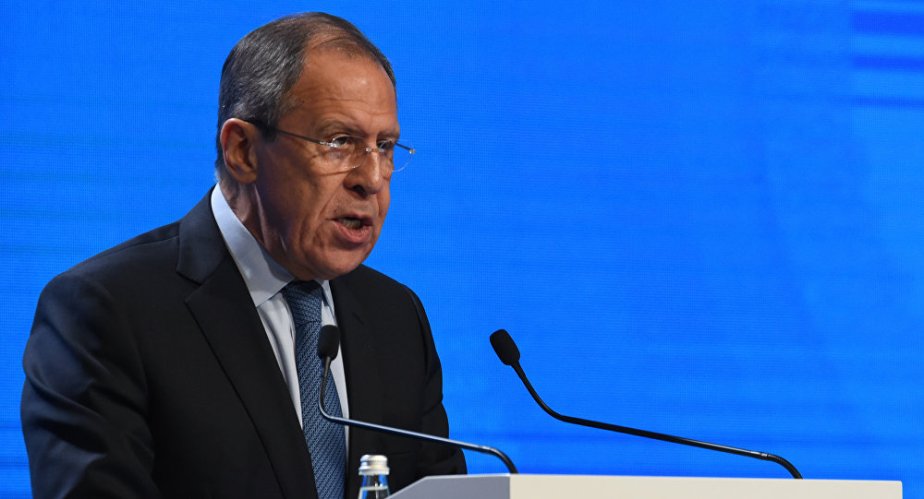
“Unprecedented terrorist aggression has been seen in Europe, the United States, and the countries that are our allies under the Collective Security Treaty Organisation in Asia – all this presents a serious threat to international security”, said Russian Foreign minister Sergey Lavrov addressing MunichSecurity conference.


Russian minister expressed concern over the overall degradation of the situation in the Middle East and North Africa after ‘Arab Spring’, and migrant crisis in Europe, pointing at  the threat of terrorism to expand in Middle East, North Africa.

Lavrov claimed a  “certain success” in the fight against ISIS, al-Nusra Front, and the other terroristic groups, however he underlined that the international community has failed so far to create a “truly efficient anti-terrorist front”, blaming  “inability” to put aside nonentity matters, and curb geopolitical ambitions.

Lavrov called for a “true union” of the leading nations against international terrorism,  and also to prevent the collapse of Iraq, Libya, Yemen and Afghanistan, infiltrated by ISIS, using the lack of unified strategy to their advantage.

Mogherini in US: ‘mission impossible’


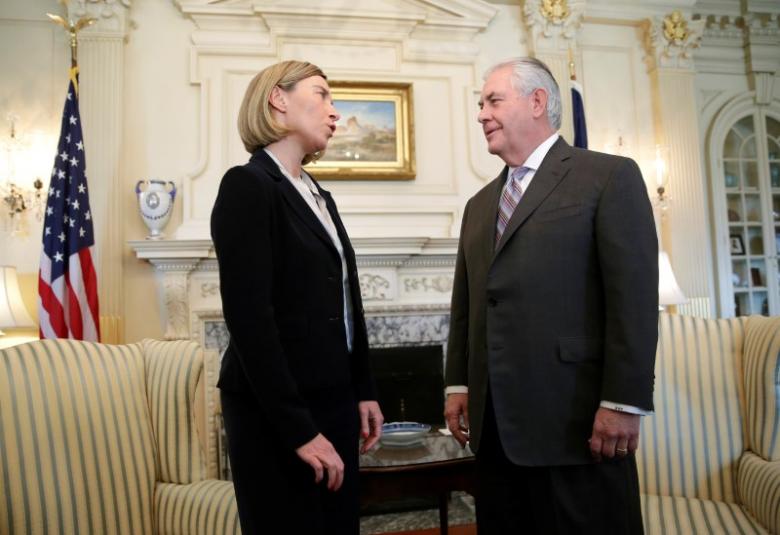
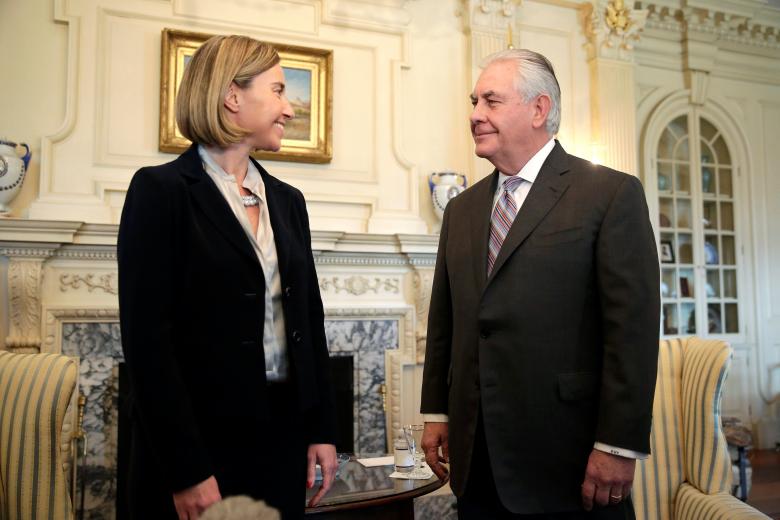
U.S. Secretary of State Rex Tillerson meets with European Union High Representative for Foreign Affairs Federica Mogherini at the State Department in Washington


Difficult to imagine less suitable personality to represent nowadays the EU diplomacy in the US, than an ardent promoter of political Islam in Europe, an Italian Socialist – Federica Mogherini, with both Socialism and Islam living winter in the EU.

However the gravity of the situation is beyond personal views and Mogherini’s political convictions: the whole disposition of the foreign policy in the EU makes her visit pretty useless a priori  as a result of an exaggerated loyalty to President Obama, and the US Democrats, the EU has mixed into the US presidential campaign supporting #Hillary, and undermining #Trump, demonstrating an astonishing myopia of the EU diplomacy, unable to anticipate the responsibly to work with any elected by Americans president.
Alas, after the US presidential elections, the EU diplomacy appeared not only to be myopic, but having as much flexibility as a gout patient, struck by multiple arthritis poor losers the EU protagonists continued opposition against President Trump, some as a policy, the others as a credo.
The leader of the European Parliament’s Socialists and Democrats, Gianni Pittella spit oil on fire accusing President Trump of manipulating the UK as a ‘Trojan horse’ to destroy the EU from within. The UK closeness with the US new President is ‘endangering worldwide democracy’,  he assumed, in an interview to anti-Trump TV news channel.
The EU Socialists were not in solitude to continuing the self-imposed ‘holy war’ against the US new administration – the appointed in an obscure procedure Pope Curia fume style, the president of the European Council Donald Trump threw his glove, publishing an open letter, naming President Trump among ‘threats’ to the EU unity. Although odd for a conservative liberal, the personal views of Tusk were also circulated in the world media, downgrading already hostile mood of the ‘Trump-era’ EU-US relations.
The head of the European Commission,  Jean-Claude Juncker did not stay aside, adding his share to ‘anti-Trump’ rhetoric, blaming him ‘populism’, and similarities with European raising nationals, very much appreciated by latest, already seeing inspiration in Trump’s anti-terroristic legislation.
So far the only head of the EU institutions, who showed a diplomatic attitude to the EU-US relations was the new Chair of the European Parliament, a compatriot of Mogherini – Antonio Tajani from the centre-right, although his moderate attitude can be explained by his rise after the US elections. Tajani restrained from confrontational remarks, explaining that in his position he will express the views of the EP as a collective body, but not of his own. A reasonable approach, but not a panacea, as there hardly any ‘collective’ views in the EU in foreign policy.
Within a growing schism among member states on all the major issues: Russia, Syria, Libya, Iran, Palestine – there is no one single big dossier evoking genuine unanimity.
Mogherini ‘sympathy’ visit to Tillerson, with no results and no perspectives, no common grounds and no common interests, reveals the naked truth of the profound crisis of the EU, reflected in the illusionary errands of its top diplomat. However one conclusion of this visit is definite: in gambling with the US elections, the EU lost it political capital, and Brussels, as de facto capital of the EU lost, as consequence,  its significance as the world’s diplomacy stage.


Published in @BrussselsDiplomatic

USA: Tillerson received Mogherini

U.S. Secretary of State Rex Tillerson meets with European Union High Representative for Foreign Affairs Federica Mogherini at the State Department in Washington

The EU top diplomat  Federica Mogherini had her first meeting with new U.S. Secretary of State, Rex Tillerson on Thrusday 9.02.2017. discussing Transatlantic relations, the common challenge of countering terrorism, the ongoing work to strengthen European Defence, relations with Russia, the Iran nuclear deal and the main crises from Ukraine to Syria.

“I was pleased to meet Secretary Tillerson. We had an open exchange on many dossiers we are dealing with. The European Union and the United States have a longstanding relationship and we will work to bring it forward on the basis of our principles and our interests. There are many files on which the EU and the US have an interest to closely cooperate,” Mogherini said.

She underlined the mutual interest to build on the longstanding cooperation between the European Union and the United States on the main international issues.

They agreed to continue working together and meet again soon. Mogherini has invited Secretary of State Tillerson to address the EU foreign affairs council in Brussels at his earliest convenience.

Later in the day, she will also meet White House Advisor, Jared Kushner, and U.S. National Security Advisor, Michael Flynn.

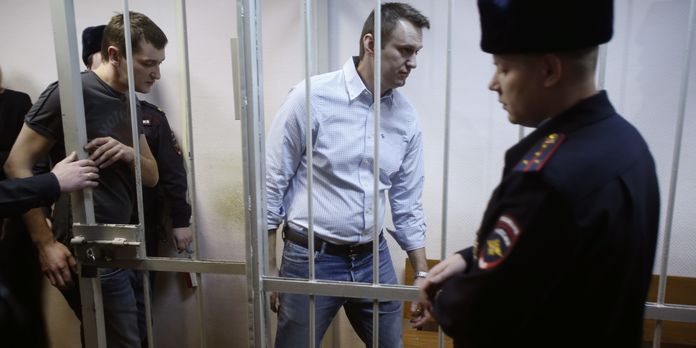
Navalny conviction means Putin forever

navalny-barred

Barring of Russian politician, and fighter against corruption, Alexei Navalny turns next year presidential elections into a soap a long time before it starts. The powerful opponent of Vladimir Putin is out of the race, so Kremlin can be sure there will be no unpleasant surprises while opening of ballot boxes.

The farce of the politically motivated trial does signal a clear message to Russians, and to the world: the authoritarian is there to stay. In a way Putin beats Leonid Brezhnev record of 18 years: from inauguration on 7th of May 2000 to potential 2024 makes his reign 30% longer that the tzar’s of late Soviet stagnation.
The mechanical removal of Navalny is meaning Russia’s return to its very self, developing from crisis to crisis, with biological renewal of the leadership over lengthy periods of stagnation in between.. “White tzars, red tzars, grey tzars”, – Johan Le Carre’s definition of Russia’s political history can’t be described better in a few words.

EU foreign policy drama

migrants-bodies-on-coast

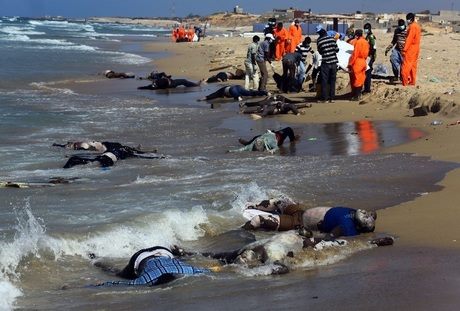
With flows of migrants from Libyan cost, the EU Southern Neighbourhood, ravaged by Islamic terrorists, and the defrozen conflict in the EU Eastern Neighbourhood with tanks moving along the vicinities in Donetsk, the EU foreign affairs Council, 6.2.2017,  finds itself in the worst situation in years, if not in decades, since the Balkan war.

Both problems have one element in common: the active involvement of the EU in shaping of the future of the neighbouring countries. The zeal of the implementation of the Neighbourhood policy in Ukraine led to the break of pro-European and pro-Russian populations, while the overthrowing of the Libyan ‘tyrant’ caused a turmoil on a half of the African continent.
Due to the EU efforts Libya from a donor became an acceptor, requesting funds to keep the flows of migrants on its coasts. 200 000 euro of taxpayers money were pledged to UN-backed Government of National Accord (GNA), while the destiny of Colonel Gaddafi’s fortune of 200 000 billion, as reported shortly before his assassination, remains obscure. However,  even if donated as agreed the major question remains if there are structures and institutions able of the implementation of the programme to improve the conditions of migrants, and fight against the smugglers.
GNA hardly controls Tripoli, where recently an explosion next to Italian reopened Embassy brought into focus grave security concerns for corps diplomatique, already shuttered by the tragic death of US Ambassador Stevens.
The EU mission on its page still calls it an ‘exiting’ time:
“It is an exciting time to be in Libya as the country is seeking its path towards democracy and stability. Just over two years ago (! -av), the Libyan people showed to the world that popular will could prevail over a ruthless dictatorship. For their courage and determination, Libyans gained the admiration of the whole world”, – although unlike Italians they prefer to watch if from the safe distance of ‘Prestige Business Center Bloc’ in Tunis.
Obviously impossible to compare ravaged by jihadists Libya with the  ‘Anti-terrorist operation’ (ATO) of President Poroshenko in Ukraine, the latest active fighting at the front line in Avdeevka, next to Donetsk endangered Minsk agreements, showing the fragility of the situation there and a huge ambition of Kiev’s leadership to conclude ATO, even at cost of the devastation of once wealthy industrial region of coal-mining.
Till present on contrary to the EU expectations the prolonged restrictive measures against Russia have not delivered an expected result to force Kremlin to abandon its support to two self-proclaimed Republics of Lugansk and Donetsk.
However the sanctions have an effect of the European agricultural sector and business, suffering losses as the result of this policy: the rise of the anti-EU forces in old member states is too obvious to ignore even for myopic bureaucrats of the European external action service, risking to lose their jobs soon, while the European nations demand referendums on EU membership from their governments, profoundly unsatisfied with the impact of  EU foreign policies on their lives.

#Fotyga: propaganda toxic substance

fotyga-ep

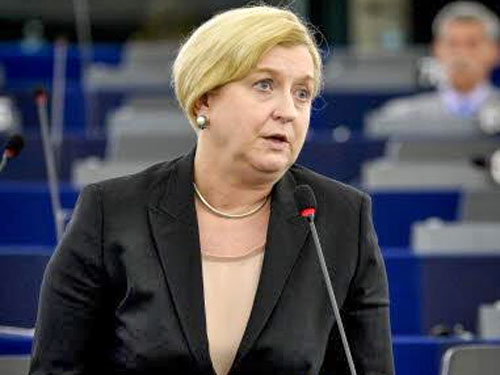
The MEP Anna Fotyga’s report on ”Russian and Islamist propaganda” debated in European Parliament is one of the most surrealistic documents produced by an assembly in modern history. Even from a first glance it looks exotic resembling a hybrid of a Nile crocodile and a red-tailored hawk – a monster from Middle Ages artist Jeroen Bosch paintings of Hell.

Certainly it is reflecting a personal animosity of Ms Fotyga – a former Polish #Kaczyński Foreign affairs minister – towards Kremlin, degrading Russian mass media undertakings to Islamic state information warfare against the West.

One can question a rational behind the choice of the rapporteur who has not been able to abandon Cold War modality in 25 years after the fall of Berlin Wall,
confusing Russia with the USSR, as if still an existing entity along with the Islamic state.

Knowing the slow pace of the EU institutions one can guess that the idea of the report was conceived in a firm believe of the continuation of the US Democrat’s policy of sanctioning Russia. Within a new political situation, when president elect has declared Russia as a ‘partner’, the Fotyga’s report looks not only dramatically outdated, but also phantasmagoria.

An obsessive wish to degrade Russia’s mass-media, namely #RussaTodayTV to propaganda machine of the Islamic state (IS) deprived the report of substance, because neither problems of the communication streams from Russia or from IS to the EU was properly addressed.
One could say that it would have been a regular piece of ‘brining sand to beach’ institutional work, if not unforeseen dangerous by effects.
Today the US election results  ensuring a change in the Western foreign policy is a key factor, making Fotyga’s report outdated, however it is more than about looks.
The presidential elections process in France indicated two major favorites: the Republican Francois Fillion and Front National Marine Le Pen – both declaring Russia as a natural partner of France. The inevitable upcoming change of the foreign policy course of the founding member state of the EU, will have a profound influence on the EU-Russia relations confronting the East European countries with a necessity to abandon chronic Cold War modus vivendi.
The reluctance to change attitude vis-à-vis Russia would create additional divides in relations between EU old and new member states, already existing in the issues of migration.The rejection of Poland to take fair share of migrants from Italy and Greece completed with the rejection of accepting a pragmatic approach towards Kremlin might be too much for the Union to bear: these cracks will start a tectonic shift between Eastern (Vicegrad group) and Western Europe,signifying its end of the status quo EU27+UK earlier than #Brexit happens.
Turning to a really burning issue of finding an anti-dot for the perilous ideology of Islamic state, Fotyga reports does not break through the standard kit of wooden language formula, already proven to be pretty useless in protecting youth from terrorist recruiters. Subsequently it would make sense to convey the preparation of such a report to a representative of a country having the most extensive experience with the IS recruiting victims – Belgium.
Concluding, one can propose two separate reports on effects of communications, offering IS to a Belgium politician and experts, and to a Latvian, where the biggest Russian community in Europe lives, to relay on first hand experience and advice.
However ending shameful practise of Russian non-citizens in the EU, namely in Estonia and Latvia would be at most effective promotion for the European values without any ‘counter-propaganda’ strategies to invent. It is hardly makes sense to invest money in development of virtual projects, describing wonders of Europe to the EU Russians who continue stateless existence long after the collapse of the USSR.
Finally, the simple arithmetic shows the malaise of the European politicians voting the controversial Fotyga’s report converted into a resolution: 304 MEPs for, 179 against, 208 (!) abstentions.
‘EU strategic communication to counteract propaganda against it by third parties’ drafted by MEP Fotyga passed, the toxic spilled, collateral damages to be estimated later.