#RoadToBrexit as a daydream

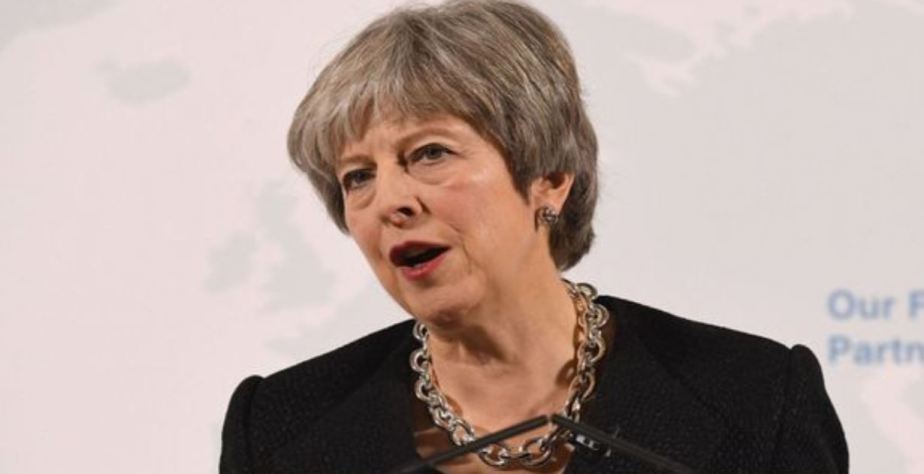
Undoubtedly the Manson House speech of the Prime Minister Theresa May has many virtues, offering constructive proposals for Article 50 agreement.  In general it is also attempts to appeal to common sense of the EU leaders, and is reflecting an intense search for the best possible new formula for matching interests of both parties, instead of fitting into old EU dogmas of ‘four freedoms’. May’s vision of the basis of post-Brexit engagement is orientated towards future: robotics and artificial intelligence, the new technologies and most of all the British genius, which brought the nation to the forefront of the Digital Revolution. But can this dazzling and dynamic new engagement attract Brussels?..

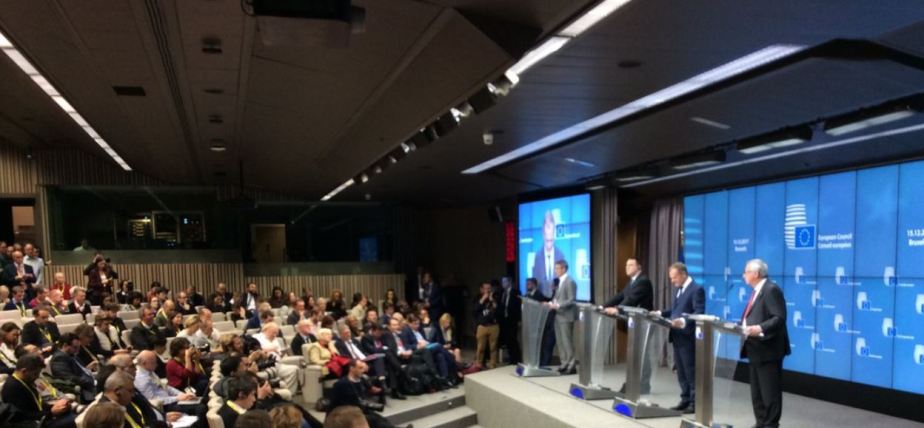
If we agree on the leading role of the “outstanding individuals” in sculpturing history, and take a close-up on European Union protagonists influencing Brexit negotiations, we’ll see that they function in totally different modus operandi than the looking forward British PM. The European Commission president (the ‘Prime Minister of Europe’) Jean-Claude Juncker is concerned with keeping the EU project intact in its original form, repeatedly referring to the forefathers – Robert Schuman and Jean Monnet who resurrected Europe from the ashes of the WWII on entirely new basis. Devoting his life to the ideas of the United States of Europe, Juncker’s major preoccupation is the risk of Brexit provoking a collapse of the entire 70 years old architecture, erected gradually after the European Coal and Steel Community united in 1950 in order to secure lasting peace.

Ideologically Juncker faces similar problems in dealing with Brexit as the Pope, who faced unpleasant news from a rebellious English King, rejecting to acknowledge his authority, and thus pay tribute to the Holy See. Juncker’s preoccupation is not to let the heresy to spread, subsequently the creation of a new ‘dynamic and vibrant’ engagement with London would be detrimental to the original project, showing to the other member-states, that life outside the EU can be so much better than inside.

In this case May’ appeal to embrace together the wonders of Digital Revolution falls on deaf ears: Juncker, as usual, is looking backward, contemplating ashes of the WWII. Keeping in mind the origins of the European project, the protection of its ‘sacred’ four freedoms from British ‘heresy’ becomes paramount. Allowing the new engagement to be a success means to give in to those, who ‘betrayed’ the great idea of Schuman, and  ‘tricked’ Britons into the trap of leave vote – an unthinkable compromise for such a ‘guardian’ of the EU Treaties as Jean-Claude Juncker.

In this context one can not exclude the ‘no-deal’ scenario, when the UK faces Brexting on WTO rules. Anyway, when dealing with dogmatics, it would be useful to keep an ace up the sleeve:)


The Cheat La Tour

Pharisees welcome to #Haiti!

Anna van Densky, OPINION

The linguistic argument over  President Trump choice of epithet to describe the situation of rampant criminality in Haiti ( 219 murders per 100,000 a year), and some other African countries overshadowed the concern with the situation itself, becoming a hysteria of Pharisees, outraged for pointing to  the unpleasant truth.

African nations started to express their protest and request apology for the unflattering comparison, being used to comfortable “politically correct” public discourse, indulging in escapism. The population rushed to express their frustration and rage in destruction. (Image below: spontaneous protests in H&M store in South Africa against epithet “shit hole”, reportedly used by President Trump.

A discussion in White House with President Donald Trump on immigration regulation that suggested asylum for people from Haiti and other likewise places, caused a whirlwind of emotions. Why US citizens  should welcome immigrants from “shithole countries” rather than from Norway? The question the President reportedly asked, according to sources present in conversation leaked to press and make headline. But it is not rate of gang rapes that concerned the general public, but an obligation to hide the abhorrent reality, making it a taboo. The next question is how to fight evil, if politicians are not allowed to raise an issue without censorship?

Pipe

“It is not a pipe!” says the line on painting of the father of Surrealism Renée Magritte. The international politics has become totally surrealistic, rejecting realities, and sheltering in illusions. While the UK FCO travel advice  (see below) warns about horrors of Haiti, Pharisees among the US #Democrats attack the President for using an epithet, slightly hinting on degradation of failed states and territories, with highest rates of murders and gang rapes on planet Earth. Pharisees do not attack the problem, they attack the President pursuing their own political aims, manipulation public opinion in their own selfish interest, waging infowar against Republicans. However it is time to establish the truth, all Pharisees should present a reason for their indignation. If President is wrong, they should leave for next holiday there:)  Welcome to #Haiti! We are waiting in anticipation for the photographs on your Facebook pages:)

FCO Haiti travel


Iran: Mogherini as ‘guardian’ of Obama legacy

Even after 20 slain protesters in Iran, the European Union top diplomat Federica Mogherini did not break her silence. After days of growing unrest, the European External Actions Service (EEAS) press person tweeted a carefully worded neutral line about monitoring the situation, and an ambivalent “being in touch” with the Iranian authorities. What about? Does the European diplomacy express “concerns” about killings, or demands to “restrain from violence”?

Where is the usual ‘eloquence’ of the 3 611 strong European diplomacy body?

In contrast to many other cases the European diplomats do not write the appropriate: “the EU strongly condemns the continued systematic, widespread and gross violations and abuses of human rights” in Iran. Neither does EU diplomacy express support to Iranian people, raising in discontent with the oppressive regime of Ayatollahs… There is no enthusiasm even slightly reminiscent of embracing Arab Spring or Maidan revolution in Ukraine. The neutrality of the EU diplomacy in case of the cause of Iranian people  is close to autism.

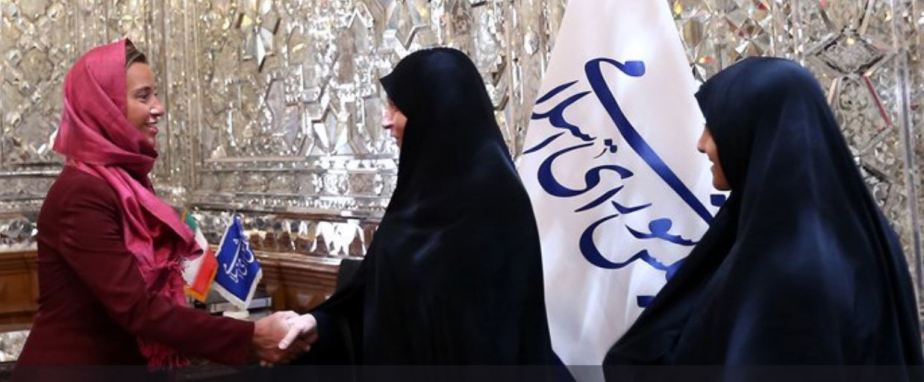
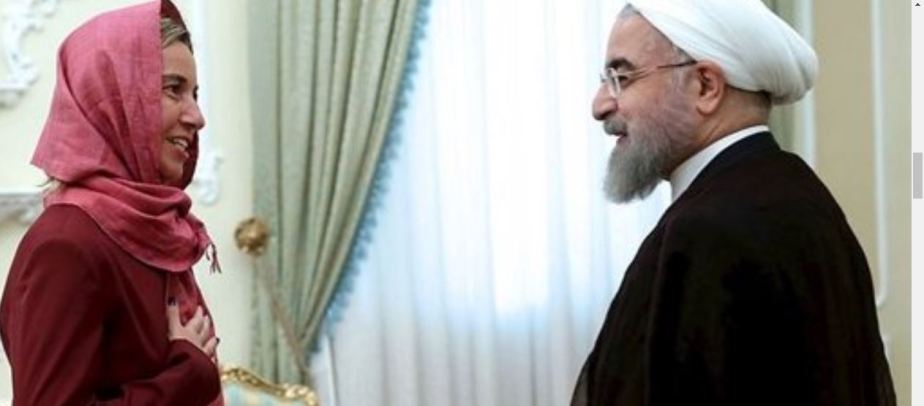
However a glance to into Mogherini’s record explains it all. An adept of political Islam, claiming it belongs to Europe, EU High Representative stretched her efforts to build an amiable dialogue with the Ayatollahs to an extend visible to everyone – the wearing of veil, a religious symbol of submission of a woman to a man, appalling to all those believing in gender equality, enshrined among top European values.

Mogherini pink veil

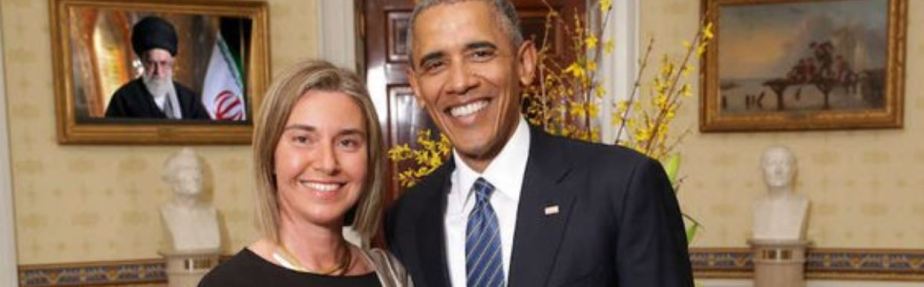
The camouflage or masquerade, as some insisted,  pleasing  of the very same clerics who defend Medieval executions by lapidation, was aimed at reaching the notorious multilateral nuclear deal with Iran, the one Mogherini defends with ‘teeth and claws’ as an ‘achievement’ of the EU diplomacy she leads; and the highlight of the legacy of Obama administration, Obama perceived as a political ally of the EU, on contrary to Trump, regarded as a foe of Brussels bureaucracy.

Image: social media.

Mogherni Obama

The nuclear deal, promoted by the EU,  giving oxygen to ayatollahs by removing international sanctions, has been widely criticised  during the presidential election campaign in 2016 by Donald Trump pledged to throw it out.

The ongoing protests of Iranian people threaten the powers of Iranian clerics, thus partners of  the nuclear deal Mogherini protects: the cause of freedom and democracy of Iranians sacrificed in preservation of a political legacy. The choice of dead silence of Mogherini confirming the EU diplomacy is a self-serving politicised clan defending their own interests at cost of promotion of  freedom and democracy worldwide. Meanwhile far away from people and their needs, EU de facto minister of foreign affairs Mogherini enjoys visit to Cuba to her Communist friends. Finale of the scene! 


Saint-Petersburg bomb explosion named “incident”

The victims of the bomb explosion in Saint-Petersburg supermarket are ironic about the qualifying of the blast as a “murder attempt in public place”: “Assassinating us for food baskets?!”. The official version is obviously doubtful, taking into consideration the fact of the home-made engine spreading shrapnel or “frag” – fast-moving pieces of metal thrown off by a detonation, leaving 10 people seriously injured, and one in a critical condition. Among wounded is also a pregnant women.

The investigation is led by the National anti-terrorist committee, however the word “terrorism” is avoided in public discourse; the video with major suspect entering the supermarket, and some other images of the interior with damages were published by the anti-terrorist committee as well. The obvious official hypocrisy has political  reasons.

Petersburg media interpreted the approach of the authorities as an attempt to play down the gravity of the situation, damaging New Year celebrations atmosphere in town. The issue is particularly delicate, because the blast happened in the home city of the incumbent and future President of Russia Vladimir Putin, who will be re-elected on 18 March under slogans of “stability” (read “stagnation”). The terrorist act during festivities, committed by an individual of “non-Slavic” appearance, as the investigators stated, is seriously undermining the Disney-land image of happy and stable Russia the clans at power are attempting to project, justifying their choice for continuity of Putin’s unchallenged reign.

The rise of Islamists in Russia is aggravated by open border with the Central Asian countries, influenced by Islamic State radicals, who are constructing a belt from Iraq to Afghanistan, via Central Asian countries, regrouping their forces after the major defeat of the Caliphate in the Middle East.

Russia 1917-2017 from “dictatorship of proletariat” to oligarchy

The rejection of registration to Alexey Navalny did not come as a surprise to him – the authorities fabricated lawsuits against the major critic of Kremlin to find a reason to block his ascendance, regarding him as a dangerous challenger of oligarchy. However the announcement brought to a conclusion a century of Russia’s development: from 1917 seizure of control over the entire Empire by left radicals led by Lenin imposing the “dictatorship of proletariat”  to 2017 Putin’s plutocracy, or “dictatorship of oligarchy” formed at collapse of Soviet Empire the end of last century.

In a way both are extremes so typical to Russian character, product of a rhythm of development from stagnation to crisis.

With the exclusion of Navalny from elections the pattern of further political development is becoming familiar: the biological change of generations. Its climax reflected in so-called epoch of “ostentatious funerals” of dying out members of Politburo, who were eager to try the crown of the fading Empire even for a few months before the end of their life, prolonged due to professionalism of Kremlin physicians. The political commentators were defining the state of play from the color of the walls behind the  leader addressing the nation, and mostly they were  grey ones from Soviet hospitals. “USSR is governed from hospital ward!” – exclaimed one of the critics of Communist party. Now a well-known scenario is awaiting Russians again.

Accustomed to changes caused by two major factors: biological and organic (hydrocarbons, or simply price of oil and gas – the backbone of Russian economy), or combination of two, as it happened during Gorbachev’s perestroika, Russians are patiently waiting for the end of the cycle, preferring stagnation to revolution. The intense search of truth in a century brought from dictatorship of proletariat to oligarchy, bypassing democracy. With vivid memories over ‘big robbery’ of Russians in the 90s, they are hardly prepared for another experiment, looking forward to a long stretch of stagnation ahead. To the winter of discontent…


Tusk squealer’s help to Russian democratic opposition

With his public declaration of being “no fan of Russia”, the president of the European Council Donald Tusk offered a squealer’s help to Russian pro-European democratic opposition at crucial time of upcoming presidential elections, discrediting their giant efforts to convince electorate that Brussels is opponent of Kremlin, but not to people of Russia. Those, who wanted to vote for opposition to Russia’s ruler Vladimir Putin, from now onwards know, that they have no friends in Brussels. The top political body – the EU Council – is chaired by an open russophobe – Donald Tusk. Many could guess previously, but this affidavit put an end to any doubt – a protagonist from Cold war times degrades the relations between Europeans and Russians.

However this ‘affidavit’ of Tusk disaffection to Russia is not only undermining the efforts of the opposition forces in Russia, because it clarifies that pro-European electorate do not have friends among the EU top players, but it also has put an end to the entire EU policy of promotion of European values, and democracy in Russia, entirely dependent on confidence of Russian people that the West wishes them well. After Tusk’s declaration this confidence was abolished: any offer from Brussels from now onwards is a poisonous chalice.

For those who followed Tusk activities from his appointment in an obscure procedure behind closed doors, the affidavit of disaffection to Russia is a finishing touch to his public profile: in opposition to the U.S. President Donald Tump, undermining the government in his native Poland,  and now openly declaring his confrontational attitude to the EU top trading partner, – Tusk demonstrates total absence of a diplomatic fiber. But not only, completely taken by his personal emotional perceptions, Tusk has been unable to raise above mediocre to level of a statesman with sense of responsibility and vision. Generously remunerated loyalty to the EU institutions, wrongly understood as an enmity to the world outside European Quarter, produced squealer’s help of an EU apparatchik, matching the worst examples of dogmatism of Soviet era, he is not able to step out.


Catalonia taking flight

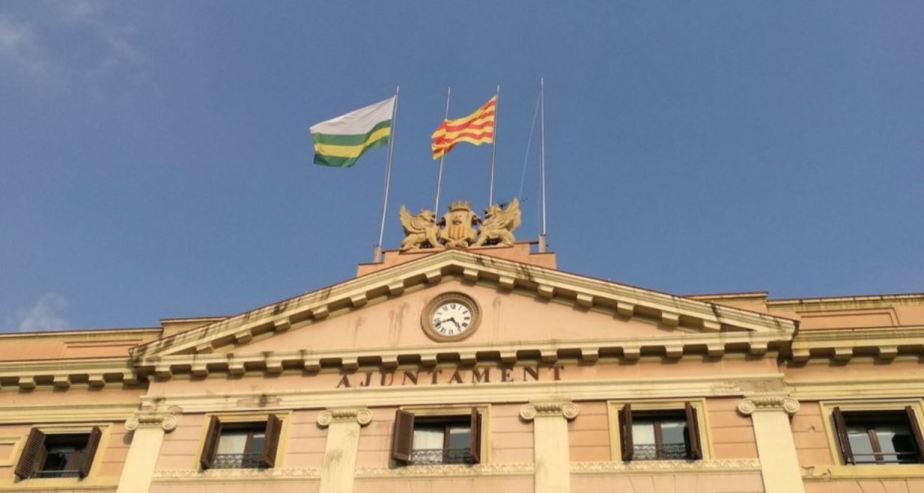
Anna van Densky, OPINION. While the entire world watched events at Iberian peninsula, the president of the European Commission Jean-Claude Juncker  looked at stars, visiting Kourou space centre in French Guiana – spaceport of France, shared with European Space Agency (ESA) for launch of Ariane6  in 2020 project.  Contemplating stars and accepting fate at a moment of birth of a new state in Europe, most probably, is the best thing to do, when there is no power to reverse events: following Brexit, one of the richest EU regions of the Mediterranean – Catalonia, has floated away.

While Madrid is obsessed with the direct rule over breakaway region, Barcelona is celebrating freedom of  Catalan Republic, waiting for recognition to come.  Although president of European Parliament Antonio Tajani ensured “no EU member state will recognize the independence of Catalonia,” the reality indicates otherwise:  politicians, feeling huge sympathy of public towards Catalonia, started to express their support:

Next to Slovenia, Finnish parliament is going to debate on the issue the next week:

On the other side of the world, Argentina will debate whether or not Catalonia is recognized, while Venezuela has always been on the side of the Catalans. The first signs of recognition will inspire the following, allowing Catalan Republic to breath freely, brushing away the threats from Madrid.

Appointing his deputy as a governor of Catalonia, Prime minister Rajoy is clearly uninterested in Czech-style ‘velvet divorce’, but attempts keeping the rich region under control by means of repressions. Punishing Catalans might be also seductive for the EU political forces at power, presuming that Barcelona sets a bad example for the other multiethnic states in the EU, encouraging them to search for independence, scattering Europe in micro-states. From the other hand there might be those who like the idea, for example, the federalists, who don’t mind Europe of micro federal states, run from Brussels.

The fears of ‘cracks’ in Europe are not caused by Catalonia, the tectonic ‘seismic’ effect came from collapse of the USSR, changing map of Europe, and opening space for new independent states, each of unique pattern, dependent of geography, infrastructure, history and culture.

Some of the new European states are stuck by misfortune, trapped in absurd of political prejudice, like Macedonia, blocked from joining the EU by neighbouring Greece in a name dispute. There are also positive examples, like Czechs and Slovaks, who had improved relations and economic ties after splitting up. However Catalonia, with it highly developed infrastructure, and a long coastline, with Barcelona among top 20 EU ports, does not need to search for a pattern to follow among any of existing models of new European states, it has all necessary elements to develop it own unique way.

Regarding the negative attitude of #Rajoy government towards Catalan independence, it does not make much sense to try to re-enter EU, where Spain would do its best to prevent Catalans to join. Pulling down EU flags along with the Spanish ones confirmed Catalans have no illusions about their possible future in EU27 bloc.

Aware of the EU deadend, Catalans are looking another direction, as the leaked vice-President Oriol Junqueras report suggests, visualising joining  EFTA common market with Iceland, Switzerland Norway and Liechtenstein.

Within this perspective, next to Brexit, Catalan departure from the EU is second blow to the image, and even more so for the budget of the bloc.

When stars are fading away from the EU flag, thinking about travelling through space to stars with Ariane6 is truly comforting idea:  per aspera ad astra!


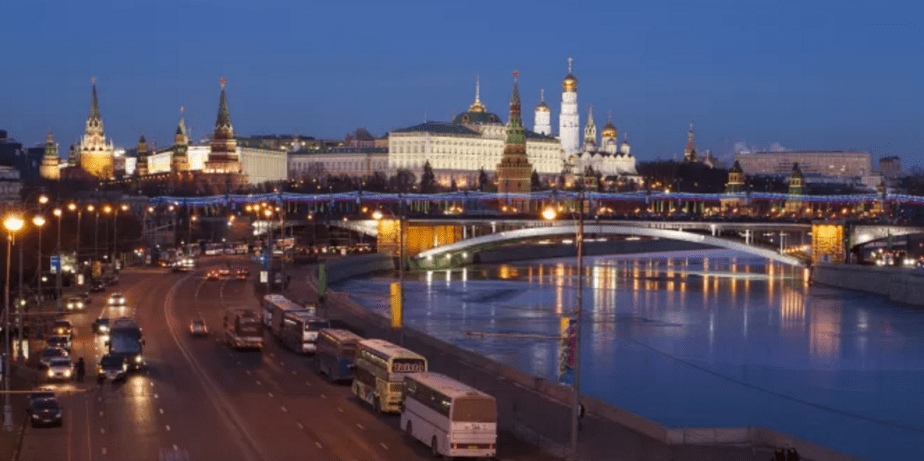
Moscow reacts with reserve on Washington sanctions

The signing of a law on tougher US sanctions against Russia, North Korea and Iran by President Trump does not change anything de facto in the current situation, the Russian President’s press secretary, Dmitry Peskov said, according to Russian TASS news agency.

“The very fact of signing the law doesn’t change anything,” he said when a reporter asked him about the impact of the sanctions and a possibility of retaliation from Russia.

“What kind of measures?” Peskov went on. “No new steps. Retaliatory measures have already been taken.”


Brexit talks in Brussels

Britain’s Brexit minister David Davis vowed to “get down to work” ahead of a first full round of negotiations, however the gap between the EU27 financial claims, and the UK readiness to contribute to Europe’s purse after departure remains huge, so is the order of talks, imposed by the bloc, insisting on settling the ‘divorce’ bill first, and arranging a new framework of relations after.

The EU27 financial claims widely considered as an Apple of Discord between Brussels and the UK government, accepting to contribute beyond Brexit in some programmes, but not in a lavish ways the EU apparatchiks desire. The departure of the second net contributor leaves a huge hole in the EU27 budget, without an immediate solution how to mend it, putting many EU projects at risk.

The incumbent EU executives are also looking for the ways to conclude their mandate without having egg on their faces for shrinking activities in European project. Many experts consider that the Enlargement to the East without respect of Copenhagen criteria, and open door migration policy undermined the EU, forcing Britons to leave. There are many forecasts the UK will not be the only country eager to end its membership in the advanced democracies club, increasingly shifting away from its original concept of stability and prosperity in Europe.

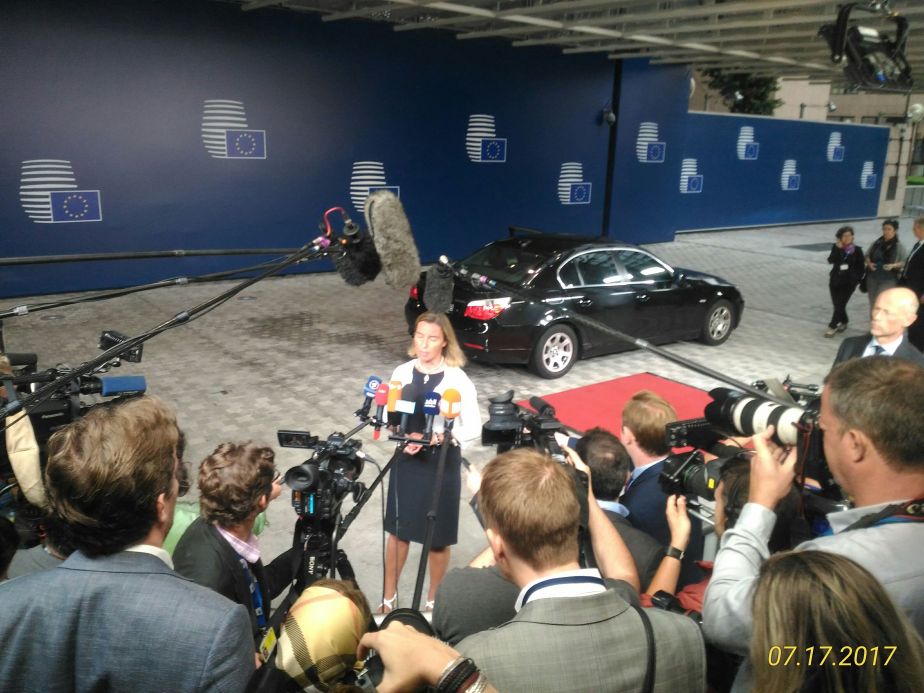
Mogherini ignores Sophia mission failure

The EU top diplomat Federica Mogherini ignores the obvious Sophia operation failure in Mediterranean, in spite of the clear will of Belgium to cancel the participation of their vessel in sea rescue mission. Mogherini also pretends to be unaware of the assessment of the House of Lords, openly stating the EU mission has failed to prevent massive migrant smuggling to Europe.

Ahead of the Council meeting the Foreign minister of Belgium Theo Francken clearly stated during a national TV programme that his country has the intention to end Louise-Marie frigate participation in the Mediterranean operation, because of the double message it sends inspiring more migrants to undertake the risky journey in a hope to be saved and transported to European coasts, thus not only saving lives but also  increasing flows of the ‘illegal migrants” eager to gamble.

The UK House of Lords report on Sophia mission is even more eloquent in its assessment, entitled: “Failed Mission”. The major recommendation is to disrupt the business model of smuggling networks through required ‘concerted action’ at Libya’s southern land border.

The Council agenda foresees discussion on migration, focusing on the situation on the Central Mediterranean route. Filippo Grandi, United Nations High Commissioner for Refugees and William Lacy Swing, Director-General of the International Organisation Migration will both take part in the discussion.
Grandi is also known for his criticism of the ‘xenophobic climate’ in Europe vis-à-vis mass migration from Africa and Middle East.