May to review counter-terrorism

Prime minister Theresa May said the UK’s counter-terrorism strategy would be reviewed. The announcement was made in the wake of the terrorist attack on London Bridge  where a van hit pedestrians at about 22:00 BST on Saturday, 3.06.2017, and immediately after the three assailants got out from the vehicle and went on stabbing people in nearby Borough Market.  The toll: 7 dead and 48 injured.

The prime minister said “it is time to say enough is enough” as she condemned a terror attack on “innocent and unarmed civilians” which left seven people dead and 48 injured in London.

Tusk: ‘good will’ for Brexit

“…We confirmed our strong commitment to the transatlantic relationship, and to further strengthening security cooperation, including between NATO and the EU” – said President Donald Tusk after his meeting with Prime Minister of Norway Erna Solberg.

“… Let me make a general remark about Brexit. These negotiations are difficult enough as they are. If we start arguing before they even begin, they will become impossible. The stakes are too high to let our emotions get out of hand. Because at stake are the daily lives and interests of millions of people on both sides of the Channel. We must keep in mind that in order to succeed, today we need discretion, moderation, mutual respect and a maximum of good will.” – said President Donald Tusk after his meeting with Prime Minister of Norway Erna Solberg.

Marion Le Pen bowed out

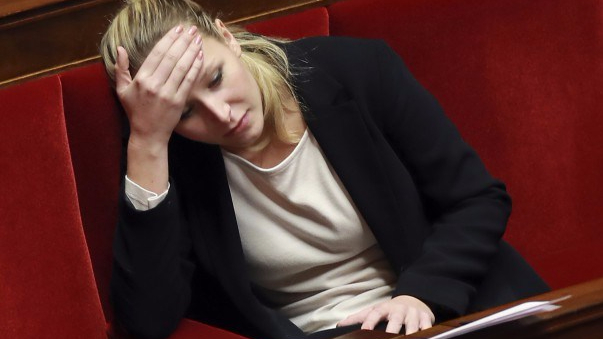
Marion Maréchal-Le Pen (27) declaration of stepping down closes the chapter of the Front National history. In spite of her young age, Maréchal-Le Pen represented the conservative wing of the party, very much associated with it founder Jean-Marie Le Pen, the grand-father and family’s patriarch. The elections showed the limits of the ‘Le Pen’ brand, unanimously cursed by the French left-wing and centrists for almost half-a-century. Emmanuel Macron received two-thirds of votes as a protest against a perspective for Le Pen family ascendance to power, not due to high opinion of his programme.

The structural changes are ahead of the Front National, led by Maréchal’s aunt – Marine Le Pen: the union with the other right-wing patriotic movements, following the successful alliance with Nicolas DupontAignan. The change of name, and further shifting to the political centre are imminent.

However impressive personal talents, charisma and presence of Marechal  are, her departure will have a positive effect of the party, allowing to switch from a Medieval congregation around one family into modern form of gathering, based on meritocracy.

Generally speaking French electorate is tired of nepotism, flourishing in ranks among French elite of the entire political spectrum, representing  a modern version of Roman nobiles, ruling in name of people, but in reality being a closed self-serving cast.

Macron faces “la cohabitation”

Macron minister

The impressive victory in presidential elections does not secure power of Emmanuel Macron, who should gain an impressive number of votes in upcoming legislative elections, 11.06.2017, to be able to realise the package of reforms proposed to his compatriots.

Among the ballots dropped for Macron a considerable amount were transferred from Republicans (Gaullist) – centre right and lesser from Socialists, – both mainstream parties endorsed their support to create a ‘barricade’ against the rival anti-globalist Marine Le Pen.

However in legislative elections every political congregation will struggle for proper seats, and it is highly probable that the Republicans will enter the coalition with En Marche!  to get the comfortable majority. In this case the Republicans will impose their Prime Minister on Macron. The ‘coexistence’ (or ‘la cohabitation) of a President and Prime Minister from different political parties is not new to French political system. In case with the Republicans (centre right) and En Marche! (centrist) of Macron it would be easier functional tandem than la cohabitation Chirac/Mitterrand (Gaullist vs. Socialist).

However, the real challenge for President Macron’s plans of reform will not come from his political opponents, but the powerful syndicates, which had already opposed ‘Macron Law’ when he served as a Finance minister, attempting to modernise and liberalise economy.  The syndicates did not hesitate to take their protests to the streets.

Attempting to reform stagnating French economy, as a minister Macron was blamed to hinder traditional French life-style, and worker’s rights, even dominical work of shops  has been largely seen as an attack on Christian traditions, especially in French rural areas.

The entering Élysée Palace as such does not give a cart blanche to reform profoundly archaic French society. The presidency of Francois Hollande was fractured when  then prime minister Manuel Valls unveiled a second pro-business reform in 2016 that allowed bosses to fire and hire workers more easily, leading to eruption of massive and violent street protests. Holland’s popularity has never risen since. Forced to give up the claims for the second mandate, the stepped down from the scene of history.  But now the pain of his departure soften by his successor, his minister, of his dauphin.

Le roi est mort,  vive le roi!


Brexit: unfair reciprocity


Workers

Anna van Densky OPINION The first set of Brexit recommendations presented by Chief negotiator EU27 Michel Barnier strikes even unexperienced in politics eye by its unfairness – there can not be a reciprocity between the population of the EU27 bloc and the UK as a major principle of talks, because of the differences in capacities both human and natural resources as huge.

Even at first glance the idea of reciprocity, put forward by Barnier is at odds with the concept of fairness. The offer of identical rights for EU27 citizens in UK, and vice versa looks just only in words.

According to the United Nations Population Division, the number of British people living in the EU is 1.2 million with the largest communities in Spain – 309,000, Ireland – 255,000, France – 185,000 and Germany – 103,000. Many of the British emigrants to Europe, especially Ireland, Italy, Germany, Cyprus, France and Spain, are self-sufficient retirees so the numbers in employment are fewer than the total number of residents.

Only in  2013/14 the UK spent £1.4 billion on state pension payments to recipients living elsewhere in the European Union, making the UK senior citizens an asset to local economies in Mediterranean countries.

The Migration Observatory at the University of Oxford underlines the fact of the UK being one of three countries which opened its borders straight away to workers from the new member states when the EU expanded to the East in 2004.

Subsequently over half of nowadays 3,2 million immigrants  – 1.6 million—of the EU nationals living in UK arrived between 2006 and 2014.

According to the Office for National Statistics (ONS) Labour Force Survey estimates for 2015, there were 3.3 million EU citizens in the UK – 1.6 million from the EU14,  (ante 2004 enlargement), 1.3 million from the EU8 (Czech Republic, Estonia, Hungary, Latvia, Lithuania,Poland, Slovakia, Slovenia), 300,000 from Romania and Bulgaria and the remainder from the other EU countries of Malta, Cyprus and Croatia.

The simple arithmetics reveals that the idea of ‘reciprocity’ put forward by the EU27 does not correlate with the idea of justice, as  the UK would be obliged to give equal rights and access to its social system to more than three million EU27 citizens in exchange for their own roughly one million living abroad looks already as a disproportionate claim.

Especially with a close-up to the social profile of the residents, while the Britons in the EU are mainly highly skilled labor or retired, while the EU27 in majority represent low-skilled labor, and their dependents.

Clearly if this EU27 claim of reciprocity persists the leaving without a deal would be the best option. The British expats can continue their stay in the legal frame preceding the UK entering the EU under a principle articulated by the Vienna Convention on the Law of Treaties 1969, stipulating that the withdrawal from a treaty releases the parties from any future obligations to each other but does not affect any rights or obligations acquired under it before withdrawal. However in this case Briton would not be obliged to sign an asymmetrical deal, meaning they have to intake 2 million immigrants above the symmetrical 1,2 million in exchange for UK citizens wishing to stay in the EU.


French ‘Revolution 2017’

Marion et Marine

The major conclusion of the first round of the French presidential election is the marginalizing of the two major political parties: centre left and centre right – the Socialists and the Republicans – sharing power through the history of the V Republic. The period  of their reign came to the end, closing the whole chapter of the post WWII political development, which is a revolutionalry change as such.

The other crucial outcome of the elections is the evolution of the Front National from a marginal force into a main stream and, moreover, number one political party, because En Marche! of Emmanuel Macron is a rather broad movement, but not a classical political congregation one can regard as a party with an ideological core.

En Marche! is a young movement, which is captivating the protest moods of the French youth, disappointed in the major political forces, however there is no classical political congregation behind him. En Marche! is not represented in the Assemblée Nationale – the parliament, so even elected, Macron would find himself in a difficulty to deal with the other experienced political forces like Republicans, Socialists, and now, very likely, the Front National. This difficulty would be only aggravated by his lack of experience in dealing with the French political system.

On contrary to En Marche! Marine Le Pen leads a solid and well-defined political force, with a comprehensive plan for governing  the country.  One of her strongest points is a programme of defeating terrorism through curbing mass-migration, ending the system of double citizenship, revoking French citizenship from involved in terrorism, etc.

Till now Macron did not explain how he is going to addressed the security concerns of the French citizens, while keeping open door policy. This is one of the multiple inconsistencies in his programme. In case he will not be unable to guarantee the security, and the terroristic acts will continue to devastate public life, the position of Marine Le Pen will be solidified, and she will continue to raise in ranks.

The  failure of a big experiment called ‘Emmanuel Macron’, will not resurrect the Republicans or Socialists, who had a chance to govern the country already, and in case of the Republicans for a long period of time, but bring the electorate to a conclusion, that the only political force that had not had a chance to show its capabilities to ‘save France’ is Front National.

In the next presidential election the frustration in ‘Macron experiment’ might lead to the necessity to continue the experimental way.  If French are so disappointed in politics that they turned to unjustified belief in a miracle of Macron ‘The Savor’, what will prevent them to put their trust in Marion Marechal Le Pen as ‘The Maid of Orleans’?..

Anna van Densky

France voting for the future

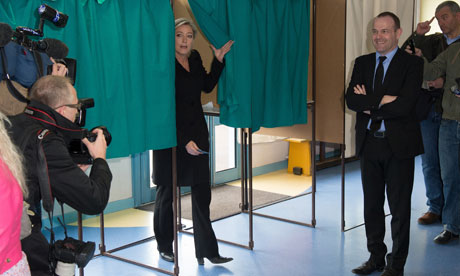
Marine Le Pen votes

France goes to the polls on Sunday for the first round of a dramatically polarized presidential election, crucial to the future of the European Union, and the destiny of the continent.

Nearly 47 million voters will choose between a pro-EU centrist newcomer breaking away from the incumbent Socialist government, a scandal-ridden veteran conservative eager to slash public spending, while accused in indulging himself in public funds spending for private gains, a far-left eurosceptic, exercising a classic repertoire to blame all the misery of the world to the rich, or France’s first woman president, promising a U-turn from globalism to nation-state.

The  latest polls indicated the two major contestants: Emmanuel Macron et Marine Le Pen, with a real battle promised at the second round of elections, while struggling to attract the electorate of the other candidates, fallen out of the race.

The rivary for the crown of the French ‘elected king/queen’ will be for the senior electorate, increasingly numerous in aging France. Remarkably seniors vote more than average,  and subsequently are over-represented among voters. The attraction of the older generation of the voters, who are characterized by specific political choices, will become a real challenge for both Le Pen and Macron. However it would not be easy for the latter, as the senior citizens have an inclination to vote a conservative political programme, and are closer to traditional values.

So far Marine Le Pen showed more understanding for the needs of the senior citizens; on the strong side of Macron  is contact with the youth, and diasporats/ immigration, especially from Muslim countries, who see in him a solid ally.

However any chosen candidate will face the  need to conquer the parliament –  Assemblée National, and the mega-challenge of dealing with French syndicates – powerful trade-unions, who keep under control economic development in the country, and the endeavours of  presidents, irrespective their political convictions.

Schaeuble: liberal world needs commitment of US

Germany Sch

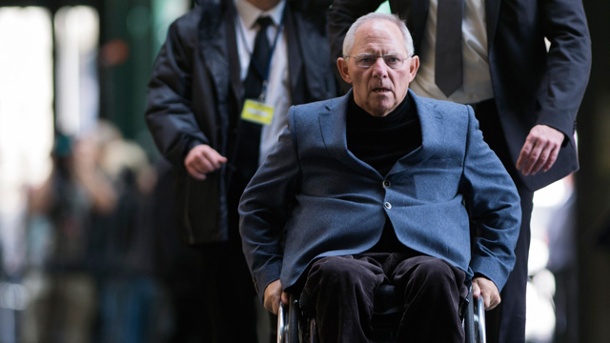
German Finance Minister Wolfgang Schaeuble said on Thursday it would be possible to develop the euro zone’s European Stability Mechanism (ESM) rescue fund into a European monetary fund soon.

Asked if this would be possible in the short term, Schaeuble replied: “Yes, I think so.”

Speaking on the sidelines of International Monetary Fund meetings in Washington, he also said any new aid programs for euro zone countries should be without the international lender and so under European auspices.

Tillerson’s visit as a glimpse of hope

Tillerson Moscow

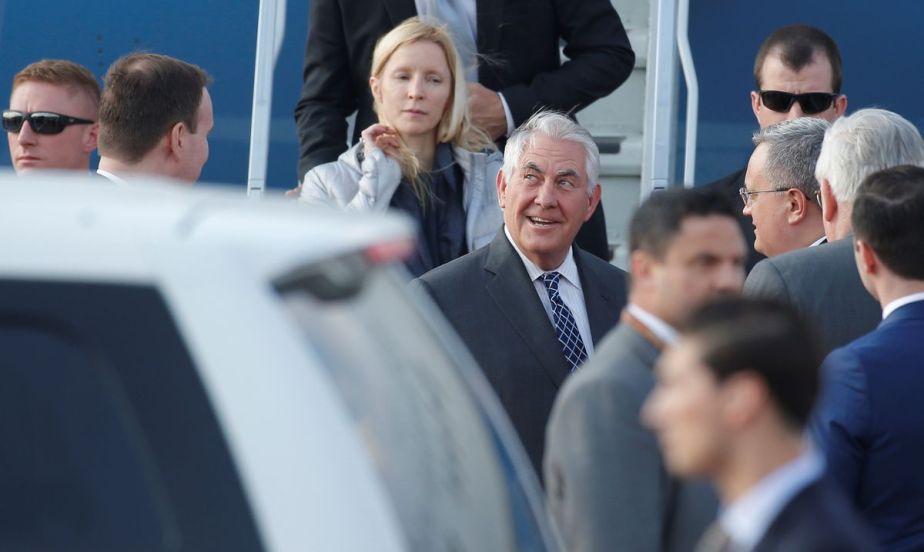
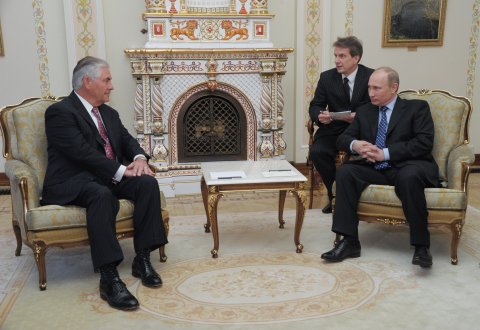
The reception of State Secretary Rext Tillerson in Kremlin gives hope that the superpower leaders are prepared to assume their responsibilities towards global community, and stabilize the rapidly deteriorated US-Russia relations.

The high expectations of Russians did not come true – the change of the administration did not bring a major change in foreign policy. Whoever is the master of the White House, it is the  US military-industrial complex having the last say.  In this way Trump’s presidency will not become any different. Bowing to the Pentagon, Trump had to retreat into admitting that NATO is ‘not obsolete’. Acceding power, he had to follow the path of his predecessors,  meaning to stay in a rut of the US expansionist foreign policy.  We all have to come to the terms that none of his revolutionary anti-war proposals, captivating the moods of his electorate, can be transformed into reality,  and both Russian and American people have to live with that sinister truth.

In spite of the economic crisis the US launched without blinking a missile offensive on Syria – the firing a shot worth USD 88 mln  demonstrates that there will be no savings on military adventures. The offensive that also left in ashes the Kremlin hope of ‘peaceful coexistence’ of the nuclear superpowers.  Syria and Ukraine as the frontlines set ablaze.

Putin and Tillerson

However the pressure of the international terrorism still might push even those the most reluctant into a coalition with Russians. The rapidly spreading network of jihadists worldwide has no other solution, but a united effort.

Although the agenda of almost two-hour discussion between Putin and Tillerson was not revealed, it is certain that the anti-terrorist coalition proposal had its prominent place.

(Photo: illustration)

Tillerson’s voyage to Moscow

Tillerson Moscow

Anna van Densky OPINION

It does not make much sense to discuss the possible outcome of Secretary of State Rex Tillerson’s (pictured)  first visit to Moscow, because the new US administration was not given an opportunity to work out their political strategy, or even modify the concept of the Obama’s administration. From the moment of the inauguration the inner political struggle took all the energy and resource, hardly leaving an opportunity to bring to live any of campaign foreign policy promises,  including the alliance with Russia against international terrorism.

While eager to play the doves of peace, the Democrats intentionally pushed the Republicans into the role of demons of war. The first visit of #Hillary to Moscow with a ‘reset button’ was a sheer public relations operation, however it worked on global popularity of Obama’s administration, profiling him on long-term as Nobel peace prize winner. On contrary the faux pas of the missile offensive in Syria shapes the image of Trump as a hawk, representing the unpredictable punitive forces with tyrannic inclinations, ignoring the international laws. Rex Tillerson’s mission is defined and shaped by this spontaneous US offensive in Syria.

However the US military action in Syria by no means is a result of a profound political thought, neither a beginning of a new strategy, but a haphazard tactical move to distract attention from #russianconnectons scandal during  the initial period of Trump’s presidency.

It seems that in the eyes of President Trump’s advises the offensive in Syria is about a creation of a backdrop to spoil the game of the Democrats, an answer to #russianconnections allegations. The allegations intensely undermining president’s Trump image in an attempt of the Democrats to win majority in the Congress in the future.

Tillerson’s call to Russians to abandon president Assad is largely a rhetoric exercise for a number of reasons, not the least an absence of an alternative – there is no opposition figure in Syria able to take the responsibilities, and enhance the reconciliation process.

The talks about dismissing Assad in military action in ‘regime change’ favorite US concept are even more surrealistic after the assassination of Libya’s leader colonel Gaddafi, whose death marked a beginning of an ongoing turmoil, transferring the entire country in a huge playground of jihadists.  Afghanistan, Iraq, Libya – the US foreign policy has demonstrated an out of ordinary capacity to destroy, but not reconstruct. Subsequently in Kremlin there is an understanding of that ‘creative capacity’ of the US, and certainly there is no slightest desire to give up a secular ally as Assad, who was educated in London, to one of the so-called ‘moderate opposition’ bearded fanatics.

The decision of Kremlin to decline the meeting between Putin and Tillerson indicates the initial pessimistic modality of the talks in Russian foreign ministry, because in first place there is no political agenda or strategy. Today State Department activity is a hostage of the warfare the Democrats declared to the Republican president, rejecting to accept his power and the choice of American people.

Without any new doctrine, scattered in tactical moves the US administration is chosing for spectacular actions and loud declarations to disguise its huge problems at home. No one expects any results from Tillerson-Lavrov (illustration) talks: Russians will not bow to the US to retreat from the Middle East, leaving Assad to the  wolves and Americans, stuck with home politics problems, will continue to use tactic of distracting of public attention from its interior weakness and failures by the belligerent rhetoric and operations, flexing steroid muscles of the military-industrial complex, – the true master of the game behind the scenes.

Dulce bellum inexpertis! *

(* War seems lovely to unexperienced, Latin)

PUBLISHED in @EuropeDiplomatic