Petroleum agent presides over Brussels press corps

Brussels 03.10.2025 The General Assembly of the International Press Association (API) endorsed a correspondent of the non-news media to preside over the journalisits’ organisation. Although officially Dafydd ab Iago @dafyddabiago (David Ferguson) has been “elected”, in reality he was endorsed because there were no competition for the position.

The situation is remarkable because he is the first chairman in half a century, who presides over the EU press corps, while working for non-news media, which means the UK company he represents as a Brussels correspondent has the following fields of endeavor: “advertising material publishing; On-line publishing of statistics and other information; On-line publishing photos and engravings; Photo and engraving publishing; Postcard publishing; Poster publishing: Printed matter publishing; Publishers (other than of newspapers, books and periodicals”. In its own words Argus Media (previously known as Petroleum Argus Ltd) is an independent provider of price information, consultancy services, conferences, market data and business intelligence for the global petroleum, and other types of energy.

https://platform.twitter.com/widgets.js

But where is journalism? Where is the construction of public discourse?
Where is prime target of journalism: serving as a forum for public criticism and search for a fair compromise, facilitating discussion and collective action for positive change?

How Argus “price information”, and “global petroleum data” ensures journalism’s watchdog function, in fact, the news media’s main role in political system? How does it increase accountability in the EU democratic governance systems? Obviously the non-news media are unrelated to journalism, while pursuing purely commercial purposes.

Subsequently the endorsement of non-news actor as the president of a the international journalist’s Association (API) manifests the state of Brussels press corps, drifting away from its original mission of Democracy’s Watchdogs.

Nowadays API unites 400 members among a thousand of the EU institutions-accredited journalists, being a specific organization for Brussels-based foreign correspondents. API claims to be first organization since 1975 to unite non-Belgian journalists of all categories and expertise based in Belgium and working for international media. The membership is open to journalists employed by one or more media outlets—whether as staff or freelancers—whose headquarters are located abroad, or who can demonstrate that their work is targeted at a non-Belgian audience, reads the introduction on the API site.

https://platform.twitter.com/widgets.js

As the representative group of non-Belgian journalists in the Kingdom of Belgium, API was created to facilitate connection between the foreign correspondents and the EU institutions on issues relevant to professional activities of the members. This includes the established set of rules, opening access to information, ensuring adequate working conditions at the EU press events, and equal access to the sources, and documents.

However during Ursula von der Leyen presidency of the European Commission which is the EU institution granting accreditation for the journalists, the access for the press-events and information has been severely restricted. The bunker mentality of Madame President is widely known, reflected in replacing press-conferences by read out of statements, “family” photos, and other photo-ops as shake hands, shifting from dialogue, answering to the questions of press to production of public relations material, and policies promotion.

This shift signifies a clean break with the previous presidencies of the European Commission, engaged in dialogue with press, and explanations of the initiatives, or decisions. The von der Leyen Commission has been systematically replacing them with advertising of the Commission’s activities, and public relations.

https://platform.twitter.com/widgets.js

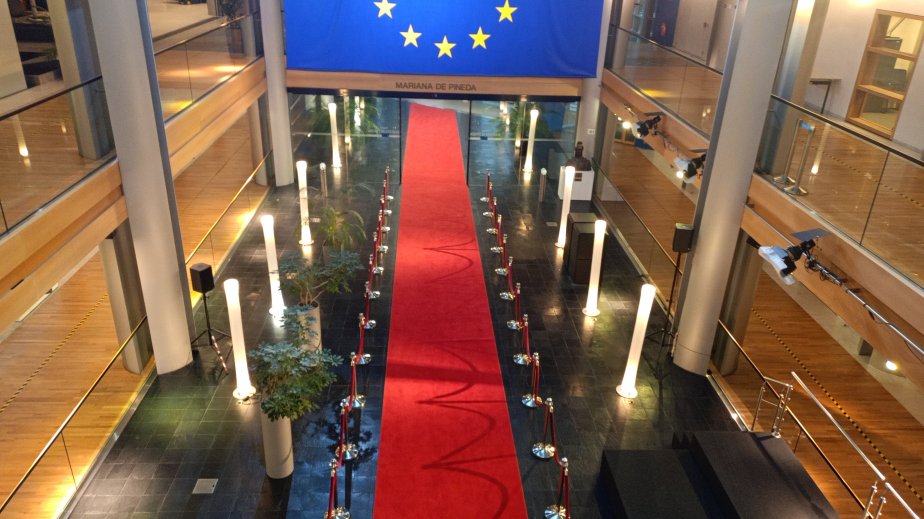
Undoubtfully Brussels journalists are experiencing the global trends of transition from legacy media to digital multimedia, the process which has multiple implications. With the Digital revolution a Homo Sapiens, a product of written culture, is transforming into a Homo Videns for whom the word has been dethroned by the image. The image plays a decisive role, floating away from a text as an abstract form of thought to a visual representation. As a result the complexity of political process, democracy, and rule of law is substituted by shake hands, red carpets, and broad smiles of politicians, attempting to convince citizens that they are guided to a brighter future. Benefiting from the Digital technologies, the beau monde of politics is increasingly reliant on power of colorful, and often doctored images.

Within this global trend, while genuine discussion through traditional mass communication channels is replaced by the mosaic of optimistic edited images, the EU Commission does not miss opportunities to shape public debate upon its agenda. The Ursula von der Leyen Commission has successfully flooded the information field with the self-advertising, and promotions, while the gap between the Institutions, and regular citizens broadens daily.

In an exclusive new report for MCC Brussels — Brussels’s media machine: EU media funding and the shaping of public discourse — the author Thomas Fazi – revealed a vast, previously under-scrutinized system through which the European Union annually disburses nearly €80 million to media projects across Europe and beyond.

“The report contends that the EU’s financial leverage creates a ā€œsemi-structural relationshipā€ with major media outlets, particularly public broadcasters and news agencies, blurring the lines between independent journalism and institutional communication — and seriously compromising the media’s ability to hold power to account” Thomas Fazi writes.

The European Commission and European Parliament collectively disburse close to €80 million annually to media projects, including major news agencies, who are used by the other types of media as a prime source of news distribution. The MCC report concluded a conservative estimate of one billion euro (€1 billion) in funding during the past decade. This figure doesn’t include indirect funding streams — for example, advertising or communication contracts awarded to marketing firms who then redistribute funds to major media outlets.

The European Commission system of replacing journalism by public relations, and advertising was shuttered by Brexit, which revealed the immunity of a large part of the electorate to the efforts of the EU institutions to promote their agenda, disguised in “independent” media discourse. However it after the departure of the Brits, the EU institutions’ methods became more aggressive, adding active censorship. The EU citizens have especially felt it during the pandemic, and beyond, when the battle for freedom of speech climaxed in EU Commissioner Thierry Breton clash with Elon Musk. The owner of X (formally Twitter) platform dabbed former European Commissioner for Digital Affairs a “tyrant of Europe” for his relentless efforts to impose censorship on social media via the EU regulations of the digital platforms.

https://platform.twitter.com/widgets.js

The public battles for freedom of speech, and censorship are shifting Overton window, so do the other, less noticeable, but not less significant actions, for example including non-news agents into journalistic communities, and then promoting them to lead. The endorsement of non-journalist as a president of the Association of the International Press is one of these Overton shifts. The replacement of journalists by advertising, and other commercial publications agents is not only a precedent, it is decisive vector of development, which will allow to ditch the role of press as democracy watch dogs to favor the European Commission lap dogs, without attracting much attention of the general public to the surrogate.

“This latest episode simply confirms the disgraceful state of the EU press corps, and Brussels-based journalists more in general, which have forsaken their role of watchdogs a long time ago and today largely act as PR agents for the corporate-political interests which fund their operations, which happens to include the Commission itself, which funds a large number of media outlets across Europe, as I show in my report, – Thomas Frazi wrote, commenting on the situation.-With the non-news media agent, leading the Association of International Press. – The result is that there is basically zero real scrutiny from the Brussels media of the Commission and von der Leyen’s policies, as the latter’s embarrassing press conferences attest to. The good news is that more and more people are starting to realise just how corrupt the traditional media are, and no longer give much credit to what they have to say. So as the propaganda becomes more pervasive and blatant, it also becomes less effective”.

EU Media: Ursula’s Colonial remnants

Brussels 30.03.2025 During the hearing on the European Commission self-glorification “propaganda” the MEP Elisabeth DIERINGER ( @E_Dieringer_MEP ) said that she is concerned with the accumulating of accreditation refusals for independent journalists, who are not allowed to enter the institutions press-events.
The problem manifested itself during the second term of Ursula von der Leyen in a way it became visible to broader public. Less than modest presence of journalists during press-conferences can be perceived by a TV spectator as a lack of interest, however if one takes interest in the EU Commission accreditation rules an alternative vision of causes of this feeble presence occurs. It is also useful to remind that accreditation is a form of public control of the institutions performance.

https://platform.twitter.com/widgets.js

To receive the annual accreditation to the EU institutions: the press-centers of the European Commission, European Council, and the European Parliament, a journalist should be compliant with three criteria: become a resident of Belgium, regularly cover the EU affairs, and… pass the financial screening.

The financial screening is described as follows: “journalism must be the main source of income”, meaning a candidate should submit the totality of financial documents for last two years to an anonyms Committee composed by an unknown criteria, who will consider the entirety of the income, and pronounce their judgement. Within these rules, imposed by Ursula von der Leyen Commission two elements are especially striking, the request to submit the financial documents without any frame to guarantee proper handling of the private financial information; and anonymity of the “judges”.
@MCC_BrusselsThese Commission financial screening demands are at odds with the rights of media companies to keep the information about the fees to freelances confidential. Paradoxically Ursula von der Leyen has been ultra defensive regarding the grants of the European Commission to media companies, keeping the information as top secret, although thanks to the MCC ( @MCC_Brussels) report signed by Thomas Fazi, it became clear that tens, and hundreds of millions of public funds are distributed in undisclosed procedures to ensure positive coverage of the EU institution’s activities.

On the flipside is the submitting of the entirety of financial documents to Ursula von der Leyen Commission anonyms Committee without any obligation from their behalf to guarantee a minimum discretion. On contrary to tax authorities the Commission’s Committee doesn’t establish any regulatory frame in treating this external financial information.

The other aspect of the unusual among organizations request for financial screening of the income of the journalist is the basis of this initiative is rooted in Belgium Colonial history. In 1963 King Albert II signed a law, which was officially was designed to protect the status of journalist in the society, but in reality this piece of legislation to transform journalism into a price prohibitive profession, unattainable for Africans, who broke away from Empire. Nowadays in Belgium the situation is unchanged, and preserving the legislation-remnant of the other era.
However the European Commission as an international organization is not obliged to follow the suit, and replicated the rules based on Colonial era frustrations, and inhibitions.

https://commission.europa.eu/about/contact/press-services/media-accreditation_en

Nevertheless the most egregious element is not the totalitarian impulse of Ursula von der Leyen Commission to inspect pockets of journalists as such, but establishing the correlation between earning, ana professional status, which allows those journalists who receive generous grants from the Commission to be in the first ranks in this shrouded obscure scheme. Commission distributes grants, and than grants accreditation to financially successful recipients of their own generosity. What a travesty! Ultimus hypocrita omnis…
.

EU: Ursula – Colonial syndrome

Brussels 26.02.2025 The second mandate of Ursula von der Leyen has been marked by a tight grip on press, covering the European Commission endeavors. The new rules for media accreditation are replicating the Belgium 1963 law defining the status of journalist during the crisis of the downfall of the Colonialism. Signed by the King Albert II in December 1963, the law remains a relic from a period of a further collapse of the Empire. The Belgian Congo, today DR Congo, ruled from 1908 to 1960, and Ruanda-Urundi, modern Rwanda and Burundi from 1922 to 1962, – became independent.

Obviously, after the proclamation of independence of the African colonies the desire of dominance of the Metropole didn’t extinguish, and the battle for the wealth went on, preventing newly liberated people from entering the political process in form of a debate on pages of the newspapers. The law signed by King Albert II formally defending a status of a professional journalist in Belgium in reality was transforming journalism in a cost-prohibitive occupation.

Nowadays in Belgium the law is still valid, and the status of a professional journalist, and the relevant press card are obtained after the revenue scrutiny by the Committee, which is composed upon the direct orders of the King.
The title of a ā€œprofessional journalistā€ is awarded by an official Approval Commission, composed equally of professional journalists and media directors. The members of the commission are appointed by royal decree” reads the announcement on the site of the Belgium Association of the Professional Journalists. https://www.ajp.be/la-loi-relative-au-titre-de-journaliste-professionnel/

Clearly, all of them the loyalists of the Crown. However, only loyalism is not suffice. As the Association of the professional journalists announces, the candidate for the statues has to present to the incognito Committee the integrity of the revenues, manifesting that the journalism is the major source of income.

A candidate should provide among the other documents a copy of the employment CONTRACT, or for freelancers: a proof of RENUMERATION – invoices, tax forms, etc. for the two-year period.

Taking into consideration mentioned above a contributor has no chance to obtain a status of a “professional journalist”, because it is not a number of articles, or success among readership, or other qualities, as for example a quotation index that counts. It is all about revenue, the capacity to sell the info product, resulting in a handsome income to impress the incognito loyalists in the Committee.
Doesn’t look too independent, neither modern in the Age of the Fourth Industrial Revolution, however this system is still effective in filtering the authors who are at odds with the mass-media system unable to sell. The professional journalist in Belgium is the one who is able to successfully merchandise his info product, which makes money the only measurement of a professional success, and opens doors for a professional affiliation.

More than half-a-century later Belgium 1963 law, protecting professional journalist status, or in reality filtering all the descent, narrating the uncomfortable truth which is not always suitable for sale, got second life thanks to Ursula von der Leyen. One can notice to what extend she takes the re-cycling seriously!

Skillfully von der Leyen replaces the Monarch in this new Commission accreditation rules, and the role of the former Colonies subjects is offeredĀ  to the EU journalists, who should proof that they are successful in merchandising their information products. The situation is even more ambivalent because the Commission refuses to issue a list of mass-media enjoying Ursula von der Leyen generosity, manifesting itself in lavish grants. As it was revealed in the MCC report by Thomas Fazi some of the recipients of the Commission “support” as the EuroNews TV Channel through years received hundreds millions omitting to inform the audiences about it.

https://platform.twitter.com/widgets.js
Exactly as in Belgium 1963 law the Committee, attributing the accreditation, is formed by Ursula von der Leyen Commission. The composition of the Committee, the names of journalists, or media they are representing is unknown. Incognito. Do the incognito members of the selection Committee enjoy grants from the Commission? Unknown. What are the rules for handling the presented financial documents? Unknown.Ā 

However to obtain the European Commission accreditationĀ  “Journalism must be their main source of income”, and for that purpose all the integrity of the revenues of a candidate should be presented for the scrutiny by unknown individuals, probably sponsored by the very Commission to buy their loyalty.Ā 
Patrons and clients.Ā 

https://platform.twitter.com/widgets.js

Emily O’Reilly, a former journalist, who served till recent as the EU Ombudsman said that her ambition was to “support the EU institutions in becoming more effective, transparent and accountable”, however by the end of her two terms she acknowledged with sadness in a podcast that she was ā€œnever at easeā€ with the ā€œpowerful consiglieriā€ from the Commission president’s cabinet. ā€œConsiglieriā€ is a specific term used to describe a position in mafia structure in Sicily or Calabria, clearly used in this context intentionally.

EU further restricts freedom of speech

Brussels 24.02.2025 The EU Commission cheered the Council’s adoption of the 16th Russia sanctions package aligned with the III year anniversary of the Russia-Ukraine war, including ban of a number of Russian mass media outlets.

https://platform.twitter.com/widgets.js

“As Russia’s illegal aggression enters its fourth year, this package is designed to further ramp up pressure on the aggressor and is part of the EU’s unwavering commitment to a just and lasting peace for Ukraine” reads the official text.
“In the 16th package, the EU has extended the prohibition to broadcast content to 8 Russian media outlets (EADaily, Fondsk, Lenta, NewsFront, RuBaltic, SouthFront, Strategic Culture Foundation and Krasnaya Zvezda) because these are under the permanent control of the Russian leadership and systematically participate in spreading misinformation and propaganda, which constitutes a threat to the Union’s public order and security” the reads the text of EU Commission Q&A page.
The explanation resonates with the words of the U.S. Vice-President J.D.Vance at Munich Security Conference: “…Now, to many of us on the other side of the Atlantic, it looks more and more like old, entrenched interests hiding behind ugly, Soviet-era words like ā€œmisinformationā€ and ā€œdisinformation,ā€ who simply don’t like the idea that somebody with an alternative viewpoint might express a different opinion, or, God forbid, vote a different way, or, even worse, win an election”.
However the acknowledgment of mistakes, and admitting the failures are the most complicated mechanisms of human psychology, often causing well-known effect of “continuation of investment in failure”, which is both costly, and irrational waste of precious resources, including time.
The initial decision to cut off Russia Today TV channel in breach of the Lisbon Treaty Article 11 (
https://fra.europa.eu/en/eu-charter/article/11-freedom-expression-and-information)
was a precedent to open the gates into Soviet-like era of repression of freedom of speech, which later became normalized, and shifted from periphery to the centre, becoming the major instrument of dealing with the opponents – shut down. Unfortunately the pattern causes the irreparable damages to the EU project, indicating to lack of arguments, and deficiency of moral high ground.

Ursula struggles for gender-balanced team

Brussels 05.09.2024 The European Commission president Ursula von der Leyen intends to create the first gender-balanced team of the EU top executives.

Every member state was offered to nominate one woman and one man candidates for von der Leyen, distributing portfolios among her future team in various endeavors: competition, digital services, trade, development and other. However von der Leyen’s request has been largely ignored. The deadline she set for nominations has passed and, as of September 2, more than half of the states had put forward a male candidate. Belgium, Croatia, Estonia, Finland, Germany, Portugal, Romania, Spain and Sweden have nominated a woman, while Bulgaria has nominated a man and a woman.

The European Women’s Lobby wrote in an open letter to von der Leyen last week, urging her to continue struggling: “Your leadership in achieving a gender-balanced Commission in the last term was a groundbreaking step that set a new standard for governance within the EU and beyond.”
“The continued pursuit of this balance is crucial, particularly now that women’s rights are under threat in various parts of the world.”
“We call on future EU decision-makers to take concrete measures to safeguard women’s rights and gender equality and go further to truly materialise equality between women and men.”
https://womenlobby.org/Call-to-safeguard-women-s-rights-and-gender-equality-in-the-2024-2029-EU?lang=en

Ursula: MEP Garraud complaint to OLAF

Strasbourg 14.03.2024 Complaints against the President of the European Commission Ursula von der Leyen accumulate. This time the Member of the European Parliament joint the voices of discontent, pointing to her neglect of rules the EU institution is so eager to impose on others. Ursula von der Leyen start of the competition for the second mandate was marked with a “faux pas” or a misstep, evident to many. The EU top executive started to use the resources and possibilities at hand of her powerful position to engage in self-promotion for the second mandate.

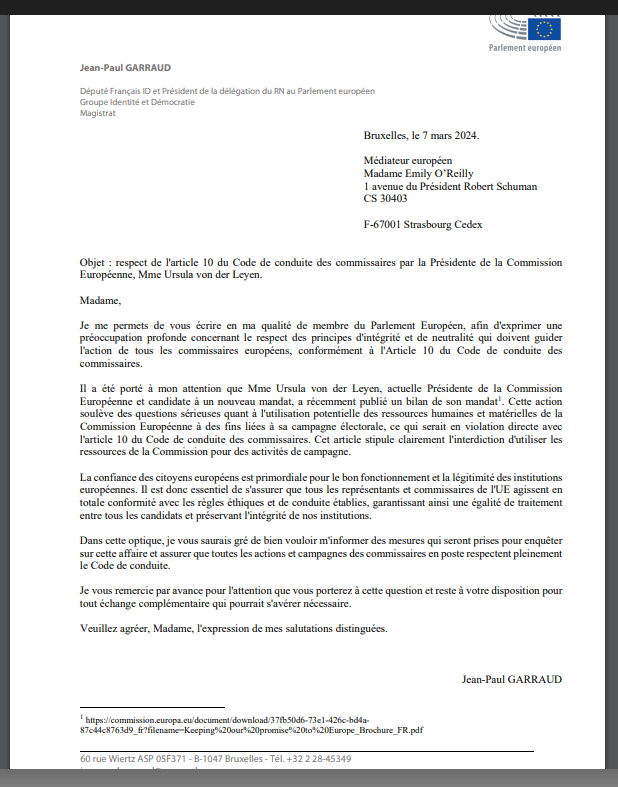
Complain Garraud Ursula

However the reality showed the opposite, and on March 7 a complaint from a French Member of the European Parliament (MEP) Jean-Paul Garraud was filed to European Ombudsman Emily O’Reilly on non-compliance with the “article 10 of the Code of Conduct for Commissioners by the President of the Commission European, Mrs. Ursula von der Leyen”. As a MEP, but also as a professional jurist, Garraud expressed his “deep concern regarding respect for the principles of integrity and neutrality” which had to guide the action of all European commissioners, in accordance with Article 10 of the Code of Conduct of
commissioners, but clearly in case of Ursula von der Leyen was ignored. (The original of the letter above).

Apparently Ursula von der Leyen, incumbent President of the Commission European and candidate for a new mandate put forward by the European People’s party, recently published a glorious assessment of her mandate on the site of the European Commission.
This self-gratification raises serious questions about misusing of human and material resources of the European Commission for “purposes linked to its electoral campaign”, which would be in direct violation of Article 10 of the Code of Conduct for Commissioners. “This article clearly states the prohibition of using Commission resources for campaign activities”, Garraud underlines. Wishing to be re-elected at the head of the European Commission the president-candidate used the site of the European institutions to promote a 56-page document “devoted to her own glory” as MEP ironically remarked.

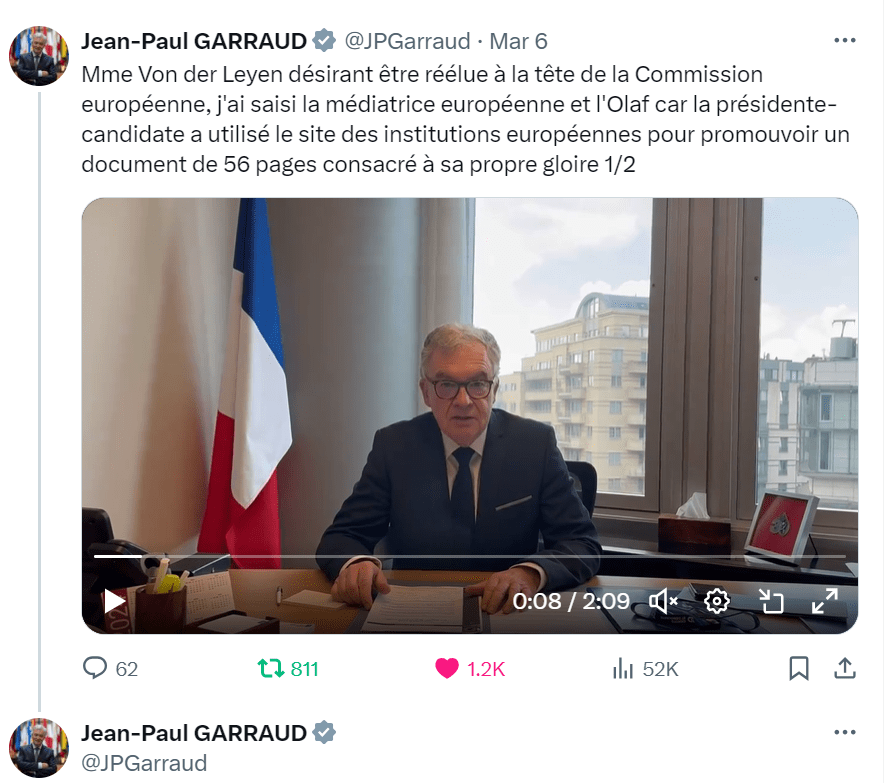
Garraud Tweet

“The trust of European citizens is essential for the proper functioning and legitimacy of institutions
European. It is therefore essential to ensure that all EU representatives and commissioners act in accordance full compliance with established ethical and conduct rules, thus guaranteeing equal treatment
between all candidates and preserving the integrity of our institutions” the MEP continues.
The text of the complaint to OLAF (depicted) resumes in a request of the investigation of the matter to ensure that Ursula von der Leyen campaign for re-election is conducted within the frame of existing rules in full respect of the Code of Conduct.

Jean-Paul Garraud is a French politician who has raised to prominence in his status as an accomplished jurist. After a long and illustrious professional career within the French justice system, this native of Toulouse turned to political life. He earned his stripes in the UMP as a French deputy where he was distinguished for his work in the National Assembly as rapporteur of several significant bills.

Nowadays Commission President Ursula von der Leyen is being sued in the Belgian courts over controversial private text messages exchanged with Albert Bourla, CEO of pharmaceutical giant Pfizer. The President of the Commission stands accused of having acted subjectively, through private wheeling and dealing, without a mandate from the EU Member States. The Commission attempted to defend the boss while saying that the messages were deleted because they were deemed to be of a ā€˜short-lived and ephemeral nature’ and devoid of ā€˜important information relating to policies, activities and decisions of the Commission’. This attitude has disappointed many, demonstrating an absence of any inclination for co-operation.

In spite of the evident public concern the Commission explanations expose the serious lack of transparency surrounding these private negotiations, which led to a purchase of Pfizer products for an
amount of €35bn. The negotiations conducted via texts attracted also keen attention of the New York Times newspaper, which resulted in a lawsuit.

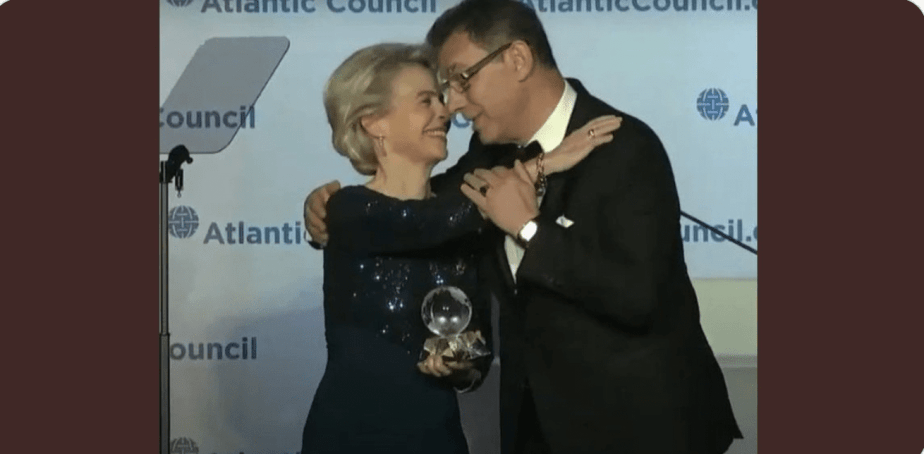
The request from the New York Times, the first media outlet to reveal the SMS affair in April 2021, was filed on January 25, 2023 and has been visible since February 13 on the public register of the Court of Justice of the European Communities . (Pictured with Albert Bourla)

Screenshot (89)

One more similarĀ  lawsuit was filed by a Belgian activist who started legal action against Ursula von der Leyen for causing financial damage to the Belgian state by negotiating the joint procurement of COVID-19 vaccines by text messages, local media reported.

Frederic Baldan, a lobbyist officially accredited to EU institutions, sued von der Leyen for causing financial damage to the Belgian state when she secured a €35 billion ($38.4 billion) deal with pharma company Pfizer to buy 1.8 billion doses of COVID-19 vaccines for EU countries, Belgian weekly Le Vif reported.

EU establishes Russia Crime Centre

Today, the International Centre for the Prosecution of the Crime of Aggression against Ukraine (ICPA) started its operations in the Hague, hosted by the European Union Agency for Criminal Justice Cooperation (Eurojust). The newly established Centre will be key to investigate Russia’s crime of aggression against Ukraine and facilitate case building for future trials. It will provide a structure to support and enhance ongoing and future investigations into the crime of aggression and contribute to the exchange and analysis of evidence gathered since the start of the Russian aggression.

The Centre will begin operating as of today. Eurojust will work closely with the Commission and the members of the Joint Investigation Team to ensure that the Centre can provide the best possible support to national authorities.

The International Criminal Court (ICC) is competent to prosecute the gravest international crimes (genocide, crimes against humanity and war crimes and the crime of aggression). However, at the moment, the ICC cannot prosecute Russia for the crime of aggression, since Russia is not a State party to the ICC. To close this gap, in November 2022 the Commission presented options to the Member States to guarantee that there is full accountability for all crimes committed in Ukraine. These options explored the possibility of establishing an accountability mechanism to allow the prosecution of the crime of aggression.

While discussions continue, in particular within the Core Group on the establishment of the Special Tribunal, it is crucial to ensure that the relevant evidence is properly secured, and that investigations can begin within the existing legal frameworks.

The evidence collected by the Centre could be used before other jurisdictions, including national and international courts, including a possible tribunal for the crime of aggression or the International Criminal Court (ICC) for crimes within its jurisdiction.

Prosecutors from the members of the Joint Investigation Centre will be relocated to Eurojust, where they can work together on a daily basis. The prosecutors will be supported by legal and analytical experts from Eurojust. Evidence identified can be stored securely in Eurojust’s Core International Crimes Evidence Database, established following the changes to the Eurojust Regulation based on the Commission’s proposal to amend Eurojust’s regulation.

EU-Russia: X package of “arsenic”

Brussels 20.02.2023 “We are approaching one year since Russia’s full-scale invasion of Ukraine” said the EU top diplomat Josep Borrell, while addressing the Members of the European Parliament in Strasbourg (pictured).

“Until today, Putin is escalating this illegal aggression, weaponising winter, food and hunger. Russia continues to show its inhuman face with brutal missile terror against civilian targets.

“The European Union has so far reacted with unprecedented support to Ukraine and nine sanctions packages. They are taking a heavy toll on the Russian economy and on the Kremlin’s ability to finance its aggression.

“Today, as the President of the [European] Commission [Ursula von der Leyen] has announced, we are putting forward a 10th package of sanctions against those who are instrumental in the continuation of this brutal war. Taking more measures, tackling the banking sector, access to dual-use technology and targeting, also, advanced technologies.

“Additionally, I am submitting to the Council a list of proposals to sanction almost 100 additional individuals and entities for their role in undermining sovereignty and territorial integrity of Ukraine.

“This includes those responsible for military activities, for political decisions, propaganda, and disinformation.

“We are targeting those involved in inhumane kidnappings, deportations and forced adoption of Ukrainian children to Russia and also those enabling the looting of Ukrainian resources.

“We will again hit hard at the Russian military and defence sector, at the organisations related to them, [and] those responsible for the development of drones that are targeting civilians and civilian infrastructure.

“And these [sanctions] are not [confined] to Russia. Today’s proposal includes a full exports-ban of several Iranian entities involved in the manufacture and provision of unmanned aerial vehicles. Yesterday, at the NATO [Ministerial] meeting, we got clear evidence that this is happening.

“So, we are proposing to sanction more key decision-makers, senior government officials and parliamentarians.

“I am proposing to the Member States to extend our sanctions to the proxy authorities and the so-called judges in the four illegally annexed Ukrainian regions of Luhansk, Donetsk, Kherson and Zaporizhzhia –who are providing fake legitimacy to the Russian rulers and their illegal decisions.

“We are imposing restrictive measures on media organisations, on persons and organisations who are polluting the public space with disinformation and malicious narratives, adding to the military warfare also through information warfare.

“We will continue to increase pressure on Russia – and we will do it for as long as needed, until Ukraine is liberated from the brutal Russian aggression”.

A new portion of “arsenic” for Russians include the following measures:

European Commission President Ursula von der Leyen and the EU top diplomat Josep Borrell have already announced details of the EU’s proposed 10th package of Russia sanctions. The X-th package of sanctions will include:

Export bans on critical technology and industrial goods, such as electronics, specialised vehicles, machine parts, spare parts for trucks and jet engines, as well as goods used in the construction sector, such as antennas or cranes.
Further restrictions on the export of dual use goods and advanced technology goods, including 47 new electronic components that can be used in Russian weapons systems, including drones, missiles and helicopters.
Export restrictions on specific rare earth materials and thermal cameras.

The addition of VII Iranian entities to the EU’s Russia dual use sanctions. This responds to Iran’s Revolutionary Guards alleged provision of Shahed drones to attack civilian infrastructure in Ukraine.
The designation of nearly 100 people and entities, including:

– those involved in kidnappings, deportations and forced adoption of Ukrainian children to Russia;
– those enabling the looting of Ukrainian resources;
– organisations involved in the Russian military and defence sector, including those responsible for the development of drones that are targeting civilians and civilian infrastructure;
– key decision-makers, senior government officials and parliamentarians;
– proxy authorities and judges in non-government-controlled Ukrainian regions of Luhansk, Donetsk, Kherson and Zaporizhzhia; and
– media organisations, people and entities responsible for disinformation.

Measures to prevent circumvention, including the creation of an ā€œoverviewā€ of all frozen assets of the Russian central bank held in the EU alongside Member States. President von der Leyen said that this is crucial in view of the possible use of public Russian assets to fund reconstruction in Ukraine.

President von der Leyen also said that the Commission is organising a Sanctions Coordinators Forum. Subsequently she called on Member States to adopt this package swiftly with the aim of having significant sanctions in place by 24 February 2023, the 1-year anniversary of Russia’s aggression against Ukraine.