EU: Ursula – Colonial syndrome

Brussels 26.02.2025 The second mandate of Ursula von der Leyen has been marked by a tight grip on press, covering the European Commission endeavors. The new rules for media accreditation are replicating the Belgium 1963 law defining the status of journalist during the crisis of the downfall of the Colonialism. Signed by the King Albert II in December 1963, the law remains a relic from a period of a further collapse of the Empire. The Belgian Congo, today DR Congo, ruled from 1908 to 1960, and Ruanda-Urundi, modern Rwanda and Burundi from 1922 to 1962, – became independent.

Obviously, after the proclamation of independence of the African colonies the desire of dominance of the Metropole didn’t extinguish, and the battle for the wealth went on, preventing newly liberated people from entering the political process in form of a debate on pages of the newspapers. The law signed by King Albert II formally defending a status of a professional journalist in Belgium in reality was transforming journalism in a cost-prohibitive occupation.

Nowadays in Belgium the law is still valid, and the status of a professional journalist, and the relevant press card are obtained after the revenue scrutiny by the Committee, which is composed upon the direct orders of the King.
The title of a “professional journalist” is awarded by an official Approval Commission, composed equally of professional journalists and media directors. The members of the commission are appointed by royal decree” reads the announcement on the site of the Belgium Association of the Professional Journalists. https://www.ajp.be/la-loi-relative-au-titre-de-journaliste-professionnel/

Clearly, all of them the loyalists of the Crown. However, only loyalism is not suffice. As the Association of the professional journalists announces, the candidate for the statues has to present to the incognito Committee the integrity of the revenues, manifesting that the journalism is the major source of income.

A candidate should provide among the other documents a copy of the employment CONTRACT, or for freelancers: a proof of RENUMERATION – invoices, tax forms, etc. for the two-year period.

Taking into consideration mentioned above a contributor has no chance to obtain a status of a “professional journalist”, because it is not a number of articles, or success among readership, or other qualities, as for example a quotation index that counts. It is all about revenue, the capacity to sell the info product, resulting in a handsome income to impress the incognito loyalists in the Committee.
Doesn’t look too independent, neither modern in the Age of the Fourth Industrial Revolution, however this system is still effective in filtering the authors who are at odds with the mass-media system unable to sell. The professional journalist in Belgium is the one who is able to successfully merchandise his info product, which makes money the only measurement of a professional success, and opens doors for a professional affiliation.

More than half-a-century later Belgium 1963 law, protecting professional journalist status, or in reality filtering all the descent, narrating the uncomfortable truth which is not always suitable for sale, got second life thanks to Ursula von der Leyen. One can notice to what extend she takes the re-cycling seriously!

Skillfully von der Leyen replaces the Monarch in this new Commission accreditation rules, and the role of the former Colonies subjects is offered  to the EU journalists, who should proof that they are successful in merchandising their information products. The situation is even more ambivalent because the Commission refuses to issue a list of mass-media enjoying Ursula von der Leyen generosity, manifesting itself in lavish grants. As it was revealed in the MCC report by Thomas Fazi some of the recipients of the Commission “support” as the EuroNews TV Channel through years received hundreds millions omitting to inform the audiences about it.

https://platform.twitter.com/widgets.js
Exactly as in Belgium 1963 law the Committee, attributing the accreditation, is formed by Ursula von der Leyen Commission. The composition of the Committee, the names of journalists, or media they are representing is unknown. Incognito. Do the incognito members of the selection Committee enjoy grants from the Commission? Unknown. What are the rules for handling the presented financial documents? Unknown. 

However to obtain the European Commission accreditation  “Journalism must be their main source of income”, and for that purpose all the integrity of the revenues of a candidate should be presented for the scrutiny by unknown individuals, probably sponsored by the very Commission to buy their loyalty. 
Patrons and clients. 

https://platform.twitter.com/widgets.js

Emily O’Reilly, a former journalist, who served till recent as the EU Ombudsman said that her ambition was to “support the EU institutions in becoming more effective, transparent and accountable”, however by the end of her two terms she acknowledged with sadness in a podcast that she was “never at ease” with the “powerful consiglieri” from the Commission president’s cabinet. “Consiglieri” is a specific term used to describe a position in mafia structure in Sicily or Calabria, clearly used in this context intentionally.

Russia-Africa Summit announcement

Brussels 27.07.2022 Russia’s second-largest city of Saint Petersburg will host the 2023 Russia-Africa Summit, Russian Foreign Ministry spokesperson wrote on her Telegram channel on Wednesday, July 27.

“We are leaving the African continent under a heavy rain and this is a good sign,” she stated. “Thank you, friends, and we are waiting for you in Saint Petersburg next year at the Russia-Africa summit.”

The inaugural Russia-Africa summit was hosted by the Russian Black Sea resort city of Sochi in 2019. The summit was organised between October 22 and 24, 2019 and its slogan read as ‘For Peace, Security and Development.’

Within the framework of the African tour earlier this week, Foreign Minister Lavrov visited Egypt, the Republic of the Congo, Uganda and Ethiopia between July 24 and 27.

The visit to Ethiopia on Wednesday July 27 was be the final stop in Lavrov’s African tour, after which the Russian top diplomat will travel to the Foreign Ministers’ Meeting of the Shanghai Cooperation Organization (SCO) in the Uzbekistani capital of Tashkent.

The food crisis caused by the Ukraine conflict took the center stage during Lavrov’s previous negotiations and press conferences in African countries.

#BLM war on idols

Anna van Densky OPINION Ancient Greek philospher said – Patna Rhei – everything flows. Stepping out of the confinement the Europeans found themselves in a different world, violently torn apart by phanthomes of the сolonial past.

Black Life Matters #BLM movement touched Brussels, de facto the European Union (EU) capital, by pogroms of the luxury stores, but not only. The degradation of public life into a bitter argument over the colonial past has occurred suddenly as a skeleton fallen out from the closet.

People use politics not just to advance their interests but also to define their identity. We know who we are only when we know who we are not and often only when we know whom we are against” Samuel Hantington wrote in his famous “The Clash of Civilizations and the Remaking of the World Order”. Apparently a new episode of the clash is gaining momentum.

Unfortunately during this clash in Brussels the rule of law was completely buried in avalanche of emotions, detached from realities, and pursuing the fantômes of the past. The wave of the monuments vandalisation ended in a proposal for creation of the Belgium parliament commission for Truth & Reconciliation aiming at the appology for the colonial atrocities in Congo Free State in times of king Leopold II. “We, the Socialist party, believe that there should be an apology,” said group leader Meryame Kitir. However is the apology enough to build bridges between communities?

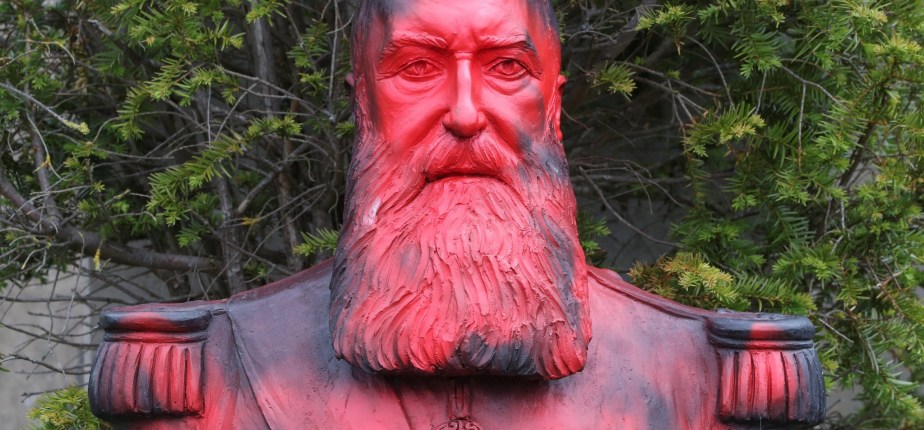
The statues of the public figures, causing the whirlwind of emotions, like the one of the Belgium king Leopold II in the first ranks, the one who owned Congo as his personal property, are perceived differently by Europeans and Africans within their retrospective cultures. If Belgiums mostly see in them the relics of the past, the Africans have much more lively and mysterious ways of relating to the sculptures as idols, materialising the idea, insuring its longevity.

For African ethnic religions, the idols are sacred tools to influence life through mysterious rituals, and even more, they are integral part of life, participating in their own invisible manner through emanation of energies. Originally they were named fétiche by Portuguese colonizers who introduced the word to set a clear difference between African idols and Christian saints, however this verbal distinction did not prevent Africans to look at the European sculptures though the prism of the own perceptions.

Another emblematic figure – Julius Ceasar was vandalised in Zottegem, Belgium, most probably in analogy with Christopher Columbus attacked in the U.S., because Caesar conquered the territory of present-day Belgium, and integrated it as a province into Roman Empire. Furthermore, it was Julius Caesar who gave the name of “Gallia Belgica“, leaving the description of the local tribes. However he also had diffiuclies there, facing a revolt just four years after the conquest.

Two thousand years later Belgica experiences the other type of migration, than Romans led by Ceasar – a total of 31,600 people have crossed into Europe illegally in 2020 so far, a drop of only 6% from the same period in 2019. Over 5,500 have reached Europe via the so-called ‘Central Mediterranean route‘, from North Africa to Europe, including 1,000 migrants in May.

Yet Libya continues to act as a magnet for migrants who come there in hope to make cross the sea and reach the European coasts, settling in one of the rich countries of the continent.

The International Organisation for Migration (IOM) estimates that in February 2020 there were at least 654,000 migrants gathered in Libya in view to cross the sea.

The top five nationalities were Nigerien 21%, Chadian 16%, Egyptian 15%, Sudanese 12%, and Nigerian 8%. Men constituted 89% of migrants, women 11%, and 7% were minors of which 24% were unaccompanied. On average the fee to reach Libya mounts up to $1,000.

Various projections indicate that mid-century African population will double reaching 2,5 billion threshold, while the Europeans will decline to 450 million. However if current trend of migration flows from Maghreb coast continue with the same frequency and intercity, from 150 to 200 million of Europe inhabitants will be from African descent.

In spite this impressive perspective of the “Africanisation of Europe” the politicians have no strategy of adaptation of European cultural environment to upcoming “African Age“. With the fast-growing African population in Europe, the request to abandon the Eurocentric concept of history was not totally unpredictable, on contrary, it was quite a logical outcome of the demographic trends. In these cirucumstances the vandalisation of the sculputres of the historic figures are emblematic, but not essential in adaptation demands of the newscomers.

The profound meaning of the transition from quantity to quality, which Hegel was highly likely the first to articulate, was one of several ways of explaining change and the mechanisms of social transformation. Unfortunatly so far both the European Union and national politics in the member-states have been ignoring the ongoing tectonic demographic transformation of the continent.

Hakuna-matata modus is over. Time to say patikana, and face and advantages and challenges of the imminent change.

Congo ‘Red Prince’ wins presidency

The victory  of ‘Red PrinceFelix Tshisekedi (53), who capitalised his father’s Etienne legend, upset the West, sincerely hoping that a globalist and liberal Martin Fayulu (62) former Exxon-Mobil top manager will capture the imagination the Congolese nation. However the miracle did not happen, and Congolese people, especially those, who live on less than $1.25 a day, defined as the threshold for extreme poverty, voted Socialism. In Congo 80% of population is falls under the description of as extremely poor, logically seeing in leftist Tshisekedi-son a protector of their interests with his political UDPS party programme to defeat poverty: “Vaincre la pauvreté”.

The frustration of the West hit the lowest, when they endorsed the interference of the Catholic Church in the election process, referring to it as to an ‘honest broker’, monitoring the elections, and accumulating the ‘authentic‘ data on people’s vote in favor of Martin Fayulu.

Although since the collapse of the USSR, more than a billion people across the globe have been lifted out of extreme poverty  in Russia, China, India, following the principles of the liberal system, nevertheless the charms of the Socialism in some parts of the world stayed intact. Especially among African youth, who believes in superiority of the socialism over capitalism, and in Congo the population pyramid clearly indicates the dominance of young generation with median age of 17 years old.

However the crucial factor in favor of the CongoleseRed PrinceFelix Tshisekedi is China, the major trading partner, and investor in DR Congo. The Chinese model is seen by many Africans as a genuine alternative to the Western capitalism, with the Communist party keeping business ambitions framed. Led by Communists, Chinese annual trade with Africa has amounted to $220 billion, making it Africa’s largest bilateral trading partner.

Congo possesses half of the world’s cobalt reserves, and is high quality copper, both in growing demand of modern high-tech industries, assessing Central African country as one of the richest in the world in raw minerals with $24 trillion worth.

However Chinese companies are not just trading in raw materials, but spending $3 billion to build roads, hospitals and universities in Kinshasa and throughout entire Congo. The barter is part of a new philosophy of Communist party that combines development aid and mineral concessions in a package deal. It’s a business model the Chinese are replicating across the African continent, infusing their influence though aid at the most rapidly growing market in the world. Within this economic realities, the victory of the Socialist candidate, is also a reflection of the Chinese Communist party growing influence on African continent.


Congo: EU sanctions failed again

The expulsion of the EU Ambassador Bart Ouvry from the Democratic Republic of Congo is a serious blow to the image of already weakened by Brexit block. In multi-polar world Congo will be not short of friends and those, willing to co-operate with one of the richest African nations. The EU is losing again its positions, due to its outdated foreign policy, inclined to give unsolicited advise and tutorials on democracy and human rights. The price to pay is high – in face of one diplomat, Congolese government turns its back on 28 European states for at least a decay to come.

The EU insistence on prolongation of sanctions on Presidential candidate, Interior minister Emmanuel Ramazani Shadary,  who is the incumbent President’s chosen successor, shows a very poor analysis and judgement of the situation in Congo, especially in view of a broader trend of political longevity of African leaders. It is highly likely that Kabila‘s protégé will win the bid, and it is certain, that he will not forgive and forget the position of Brussels diplomacy.

“Africa’s future is also our future,” said the European Commission president Jean-Claude Juncker said recently at high level Africa-EU Forum in Vienna. However, if the course of the EU foreign policy remains unchanged,  and rigid, soon Europe will be excluded from African future without reverse, and Africa’  future will be shared with Chinese, Indians, and Arabs.

So far the EU politics of sanctions failed wherever it was applied conducted at costs of growth and jobs, leading to impoverishment of Europeans, whose despair erupted in Yellow Vests protests in France. But who will criticize French Minister of interior for an excessive use of force against the protectors?..  Who will apply sanctions against the Interior Minister?..  Quod licet iovi non licet bovi… (What is allowed to Jupiter is not allowed to a bull – Latin proverb).

Congo’s most important export partners are: China (24% of total exports) followed by South Africa (22%) and the European Union (4%). Main imports are: foodstuffs, fuel, textiles and machinery, and leading partners: Angola (15%), France (13%) and Singapore (10%).