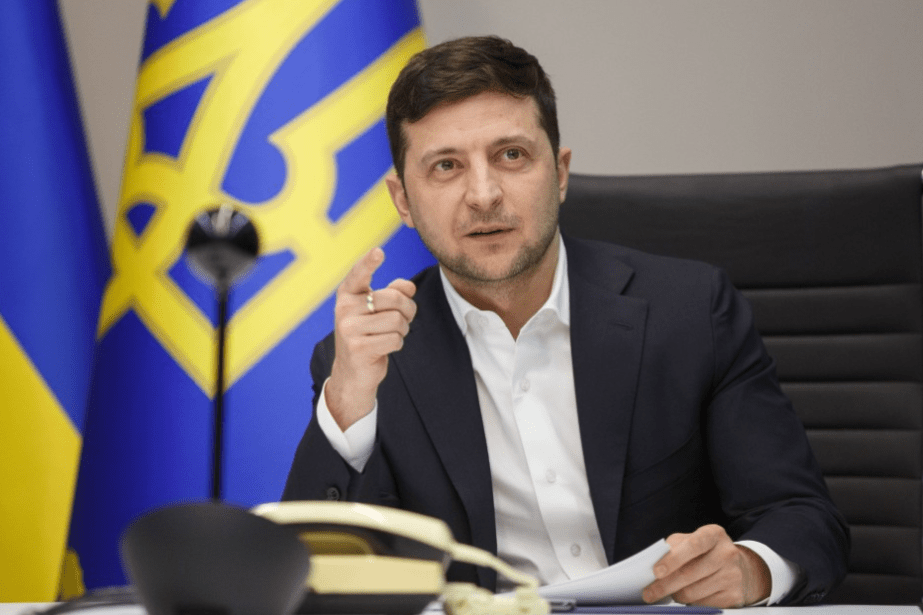
Strasbourg 13.03.2022 Anna van Densky A meeting between President Vladimir Putin and President Vladimir Zelensky is not ruled out, Kremlin spokesperson Dmitry Peskov said on the air of the Rossiya 1 TV channel.
The official added that in order to organise a relevant event, it was necessary to understand clearly the agenda of discussion and its possible outcome.
Ukrainian president Zelensky has said that direct talks with Putin were the only way to end the war. https://t.co/rLzX5WGBtv
Turkish Foreign Minister Mevlut Cavusoglu said that President Recep Tayyip Erdogan and Vladimir Putin touched upon the topic of a possible meeting between him and Vladimir Zelensky in a telephone conversation. Cavusoglu claims that the Russian president had no objection to such a meeting.
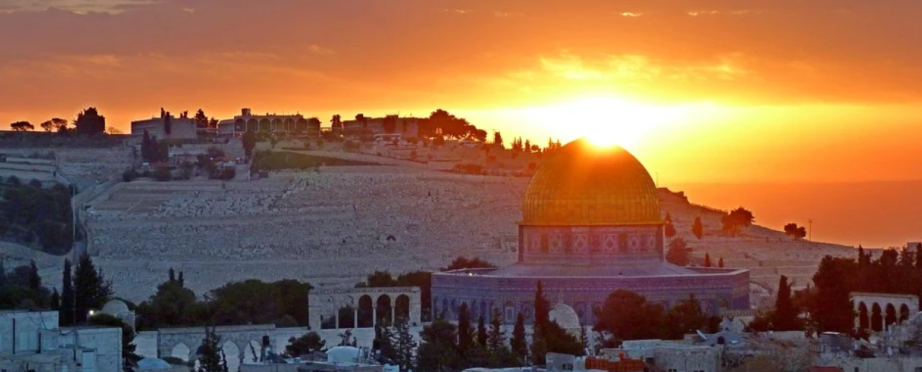
BREAKING: Zelensky expresses openness to talks with Putin in Jerusalem
On March 10, 2022, Foreign Ministers of Russia and Ukraine Sergey Lavrov and Dmitry Kuleba completed negotiations in Antalya, which were held with the participation of Turkish Foreign Minister Mevlut Cavusoglu. The meeting lasted over an hour and a half.
Israel's diplomatic role in the Ukraine was has elevated dramatically over the past 24 hours, as Jerusalem is a potential destination for Putin-Zelensky talks pic.twitter.com/qHSJ5ZYY0C
Russia has been open to holding negotiations with Ukraine in Jerusalem, a senior diplomatic source said on March 12 to Jerusalem Post newspaper, soon after Prime Minister Naftali Bennett and Ukrainian President Volodymyr Zelensky spoke on the phone.
Zelensky said earlier the same day that “at present it’s not constructive to hold meetings in Russia, Ukraine, or Belarus. These are not the places where we can agree to stop the war… Do I consider Israel, Jerusalem in particular, to be such a place? I think the answer is yes.”
Russia has not rejected the idea of negotiations in Jerusalem, the diplomatic source said, but Israel is not sure it should host the talks.
Brussels 08.02.2022 Washington seeks to keep Japan’s unfounded territorial claims against Russia afloat in order to prevent the two countries from full-scale cooperation, Russian Foreign Ministry Spokesperson Maria Zakharova said in a TV interview. Japan claims the four southernmost islands, including two of the three largest ones – Iturup and Kunashir, – as an integral part of its territory along with Shikotan and the Habomai islets, which has led to the ongoing Kuril Islands dispute between Japan and Russia.
While commenting on U.S. Ambassador to Tokyo Rahm Emanuel’s statement that Washington supported Tokyo in the issue of the Northern Territories (southern Kuril Island) and recognised Japan’s sovereignty over them, the diplomat pointed out that “over the past decades, the United States has transformed Japan from an independent state into a dependent one.”
Japan has lodged an official protest after Russia announced it would hold a military exercise starting this week in waters off Kunashiri Island. https://t.co/40UYNEuSyD
The spokesperson reminded that Moscow had repeatedly called for abandoning the “attempts to artificially pump up hysteria” and tensions around the territorial issue, while the Japanese leadership kept neglecting “the need to build normal and full-fledged economic, financial and cultural ties” with Russia. “Every time, we highlighted the artificial nature of this issue and the related tensions,” the Russian Foreign Ministry spokeswoman underlined.
MFA spox #Zakharova: Our common goal is to preserve historical truth, which is particularly important due to never-ending attempts to rewrite history of #WWII, revise its outcomes and downplay the role of the Soviet Union in the #Victory over Nazi Germany and militaristic Japan. pic.twitter.com/6JIZaXCgEV
“It is being fueled by a certain part of Japan’s political establishment. And who’s behind it? The U.S. ambassador has stepped forward and made it clear,” she added. Zakharova explained that Washington benefited from keeping the issue afloat because “this artificial problem prevents Japan from engaging in full-scale, mutually beneficial and long-term cooperation with Russia.”
The United States has urged Japan to consider imposing economic sanctions on Moscow if Russian troops invade Ukraine, diplomatic sources said Saturday. https://t.co/iGXGXizj7n
The Russian diplomat recommended that the US envoy to Japan “should spend more time telling the Japanese public about the United States’ crimes.” “Particularly, about how the United States used nuclear weapons to attack the country’s civilians in Hiroshima and Nagasaki. Unfortunately, the Japanese public knows little about the U.S. role in those tragic events,” Maria Zakharova concluded.
Brussels 07.02.2022 Anna van Densky Germany and NATO allies are ready to take “all necessary steps” if Russia “invades” Ukraine, German Chancellor Olaf Scholz said in an interview published by the Washington Post on Sunday, February 6, when asked if the German government could halt the process to open the Nord Stream2 pipeline.
“We are ready to take together with our allies all necessary steps,” Scholz clarified. “We have a very clear agreement with the United States government on gas transit and energy sovereignty in Europe.”
“We already also agreed that we will support Ukraine,” Scholz went on to say. “Also, it is absolutely clear that in a situation like this all options are on the table.”
“I will not get into any specifics, but our answer will be united and decisive,” the chancellor added.
“We are working very hard with our allies in NATO and in the European Union to make clear what we can do in the specific situation,” Scholz said. “But we are also clear about the necessary strategic ambiguity.”
“This is also critical for giving this strong message that it will be very costly — so they cannot go to a computer and count whether it will be too expensive or not,” he said. “It would be too high a price to intervene in Ukraine.”
“On the other hand, that we are working very hard to use all the channels of talks that we have now: talks between the United States and Russia, the NATO-Russia Council, the OSCE and obviously it’s also the Normandy format,” the chancellor said.
The interview came out ahead of a visit by Scholz to the US where he is set to meet with US President Joe Biden on February 7.
On February 15, Vladimir Putin will hold talks with Federal Chancellor of Germany Olaf Scholz @OlafScholz in Moscow https://t.co/yUsycZF422
There has been a various statements in the West and Kiev lately that Russia could invade Ukraine soon. Kremlin Spokesman Dmitry Peskov said they were unsubstantiated escalation and that Russia doesn’t threaten anyone. At the same time, he didn’t rule out provocations to corroborate these Western statements and warned that the use of force to resolve the crisis in southeastern Ukraine will have serious consequences.
A popular magazine mocked the German chancellor’s “art of disappearance.” Another headline asked, “Where is Olaf Scholz?”
On Monday, the answer will be in Washington, for his first meeting with President Biden since taking over as chancellor in December. https://t.co/ad02va6loU
Brussels 26.01.2022 The United States Ambassador John Sullivan on Wednesday, January 26, handed over Washington’s written responses to a sweeping set of security demands that Kremlin has made of the West, Russia’s Foreign Ministry said.
U.S. ambassador to Moscow John Sullivan on Wednesday delivered Washington’s written response to Russian proposals for security guarantees to Russian Deputy Foreign Minister Alexander Grushko:https://t.co/nbsbcm7wpqpic.twitter.com/iHjqnFcg3Y
The head of the US diplomatic mission delivered a written response from the US administration to the draft bilateral agreement on security guarantees that was earlier proposed by the Russian side,” the Foreign affaires Ministry said in a statement.
The meeting was requested by the US ambassador, who spent slightly more than a half hour inside the Ministry building.
US Ambassador to Moscow John Sullivan arrived in his car at the Russian Foreign Ministry at about 19:30 Moscow time on Wednesday, a TASS correspondent has reported:https://t.co/je59D9MDthpic.twitter.com/CyXVPNFUnx
Russian Foreign Minister Sergey Lavrov told the State Duma earlier on Wednesday that Russia won’t publish the US response on security guarantees, if asked, but will disclose the general meaning of the replies.
.@SecBlinken: Today, Ambassador Sullivan delivered our written response in Moscow. All told, it sets out a serious diplomatic path forward, should Russia choose it. pic.twitter.com/4pRMRLw1Ql
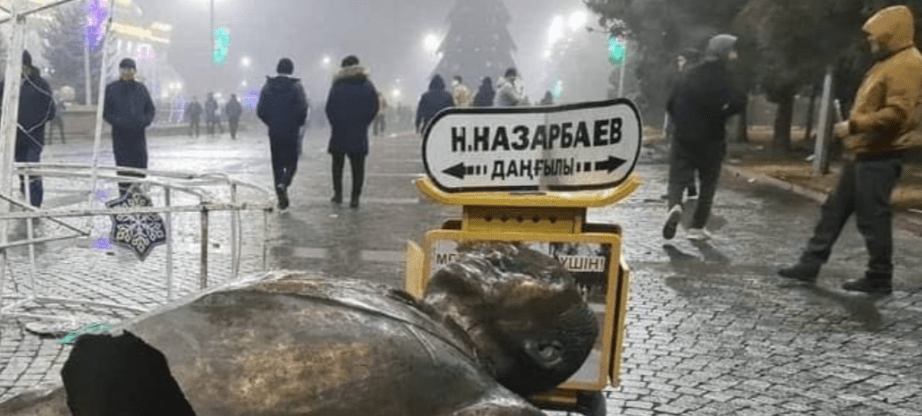
Brussels 06.01.2022 The Collective Security Council of the Collective Security Treaty Organization (CSTO) approved the decision to send peacekeeping forces to Kazakhstan, Prime Minister of Armenia Nikol Pashinyan, who chairs the Council in 2022, said on Thursday, January 6.
Russia has sent paratroopers into Kazakhstan as part of an intl peacekeeping force to quell unrest in the country, the Russia-led Collective Security Treaty Organization (CSTO) said today, Reuters reported. On Wednesday, Kazakh Pres. Tokayev said he called for their intervention. pic.twitter.com/wruGldcbv8
“In view of the address of President of Kazakhstan Kassym-Jomart Tokayev and considering the threat to national security and sovereignty of the Republic of Kazakhstan, caused in particular by interference from the outside, the CSTO Collective Security Council in accordance with Article 4 of the Collective Security Treaty made the decision to send CSTO Collective Peacekeeping Forces to the Republic of Kazakhstan for a limited period with the aim of stabilisation and normalisation of the situation in this country,” Pashinyan wrote in Facebook.
On January 2, crowds took to the streets in the cities of Zhanaozen and Aktau in the Mangystau Region, in southwestern Kazakhstan, protesting against high fuel – liquid gas – prices.
Kazakhstan: Very strong piece here on CSTO affair, by @joshuakucerahttps://t.co/0KDyc5WaBH Note sharp contrast between rapid CSTO reaction on this occasion with signal refusal to act during previous crises
Two days later, the protests engulfed Almaty, in the country’s southeast, where the police used flashbangs to disperse the crowd, as well as other cities, including Atyrau, Aktobe (in the west), Uralsk (in the northwest), Taraz, Shymkent, Kyzylorda (in the south), Karaganda (in the northeast) and even Kazakhstan’s capital Nur-Sultan.
BREAKING: Armenia agrees to deploy peacekeeping troops to Kazakhstan as part of article 4 of the CSTO treaty. pic.twitter.com/D8q5wsfqoF
The president imposed a two-week state of emergency in the Mangystau Region and in the Almaty Region, as well as the republic’s largest city of Almaty and the capital Nur-Sultan.
NOW – Situation in #Almaty, Kazakhstan's largest metropolis, spirals out of control. The president imposes a curfew and deploys the military to quell the anti-government protests. pic.twitter.com/AZIsZlhEYd
On January 5, the head of the state also accepted the government’s resignation, but vowed to keep his grip on power.
Tokayev considers what is happening in Kazakhstan to be external aggression. That is why request for military assistance made to CSTO for collective defense https://t.co/H3uwEO0TpZpic.twitter.com/gAiNd8Ybko
Reportedly 353 members of Kazakhstan’s law enforcement were injured in the clashes with protesters in Almaty, 12 were killed, the Khabar-24 TV channel said quoting the Almaty commandant’s office.
According to the TV channel, one of the victims was beheaded. “This proves the terrorist and extremist nature of criminal formations,” the commandant’s office was quoted by national media.
Kazakhstan crisis:CSTO states are preparing for an intervention in Kazakastan to help the former regime. It seems Russia is making moves using CSTO cloak. So far 8 police and national guards have been killed while 317 injured. This morning protestors set President's home on fire. pic.twitter.com/2VVd3gmfBG
Brussels 22.12.2021 Kremlin has conveyed its disapproval to Ankara via diplomatic channels over an attributing a name of Dzhokhar Dudayev, the leader of Chechen separatists, to one of the city parks, the spokesperson Dmitry Peskov told journalists on Wednesday, December 22. (Image: Caucasus, illustration)
“We have already notified our Turkish colleagues via diplomatic channels that we, to put it mildly, do not approve of such names in Turkish cities,” he said.
Chechnya’s regional leader Ramazan Kadyrov has threatened to erect the statue of PKK's jailed leader Abdullah Ocalan at home after a park in Turkey was named after Dzhokhar Dudayev – first President of Chechen Republic of Ichkeria pic.twitter.com/N24m2rxKcK
The Kremlin official also said that the reaction of Chechen leader Ramzan Kadyrov to this event was quite understandable. “This is a very emotional yet understandable reaction of the head of a Russian region who suvived several wars, several wars that were provoked, started by terrorists who attempted to take control over that Russian region,” he said. Putin’s press secretary reiterated that “one of the terrorists who did it was at some point their leader Dudayev.”
Chechen leader Ramzan Kadyrov threatens to erect terrorist PKK leader Öcalan’s statue in Grozny after park in Turkey’s Kocaeli province named after Chechen hero Dzhokhar Dudayevhttps://t.co/DCxQcNkDqp
“Recently, unfortunately, in one of Turkey’s regions one of the parks was named after this terrorist. Of course, this is a very painful decision for all Chechens, for the Republic of Chechnya within the Russian Federation,” the spokesman asserted. Therefore, in his opinion “such an emotional reaction is quite understandable.”
— Batter Kadkoy // КIэдыкъуэй Батыр (@Blechepsina) March 19, 2021
On December 21, Kadyrov addressed the Russian Foreign Ministry asking to respond to the actions of Turkish authorities. The Chechen leader also urged Turkish President Recep Tayyip Erdogan to determine whether he supports “transparent and honest relations with the Russian Federation.” According to the Chechen leader, the current actions by the Turkish authorities are a direct threat to Turkish-Russian relations, they should be noticed and preventive diplomatic measures should be taken.
Earlier, media outlets reported that a park was opened in Korfez, a town in Turkey’s north-west, named after Dudayev, the president of the self-proclaimed Chechen Republic of Ichkeria who led an armed resistance after federal troops were deployed to the region in 1994. He was neutralised in a special operation in 1996.
Strasbourg 05.10.2021 The Ukrainian president Volodymyr Zelensky may have pledged to reform the country’s corrupt system of politics, but the Pandora Papers reveals otherwise.
🇺🇦 Ukraine has the highest number of politicians implicated in the Pandora Papers, with 38 names — including President Volodymyr Zelensky.
Driving the news: Ukraine is the country with the highest number of politicians named in the leak of offshore data, which implicates hundreds of people linked to offshore companies — including President Volodymyr Zelensky, presumably fighting corruption.
Zelensky’s dream was always to be on world media’s front pages together with other world leaders. pic.twitter.com/jGjoayAAo4
Though offshore companies are not themselves illegal, they often help facilitate tax evasion or money laundering, writes the International Consortium of Investigative Journalists, the network of reporters and media organisations that obtained the records, revealing double-faced politicians.
While being a popular professional comedian, Zelensky had campaigned on reforming Ukraine’s oligarch-dominated system, positioning himself as an outsider of the crooked universe of the politicians, including incumbent Petro Poroshenko, who hid offshore assets.
Zelensky is named in the Pandora Papers for offshore accounts set up *before* the election. You have to feel bad for Ukrainians, who trusted him enough to give him 73% of the vote… after he spent the campaign railing against the exact same thing https://t.co/n4lSeCOnzL
However the Pandora Papers revealed that Zelenski was involved with a network of offshore companies, which he co-owned with friends and business partners.
Zelensky is one of several politicians who campaigned on anti-corruption platforms — others include Czech Prime Minister Andrej Babis and Pakistani Prime Minister Imran Khan — who will now be facing questions over undisclosed wealth tied to them or their close associates, Axios’ eidotor Dave Lawler said.
Ukrainian President Volodymyr Zelensky, who also has pledged to clean up his country, had offshore companies with partners.
Just before he was elected, he appears to have moved to disguise his interest. 4/ https://t.co/mNGZyZOFL2
— Organized Crime and Corruption Reporting Project (@OCCRP) October 3, 2021
By the numbers: Ukraine leads with 38 politicians named in the Pandora Papers. The top five are …
– Ukraine: 38
– Russia: 19
– Honduras: 11
– United Arab Emirates: 11
– Nigeria: 10
Strasbourg 05.09.2021 More than 600 journalists from the International Consortium of Investigative Journalists’ @ICIJorg 2021 have conducted a vast investigation named #PandoraPapers which reveals how the offshore money machine operates in every corner of the planet, including the world’s largest democracies.
The Consortium @ICIJorg has uncovered tax evasion and corruption totaling up to $32 trillion involving:
The Pandora Papers reveal alleged hidden wealth by 300+ global elected officials and 100+ billionaires.
The data has info on: ▪️ 14 heads of state ▪️ Tax havens like: British Virgin Islands, Cyprus, Switzerland, U.S. states South Dakota, Delaware ▪️ Celebrities incl. Shakira pic.twitter.com/TrYYOYit7q
The Washington Post, owned by the American billionaire Jeff Bezos, and the International Consortium of Investigative Journalists (ICIJ) gained an unprecedented look into the money flowing into trusts in the United States by examining a trove of more than 11.9 million confidential documents maintained by trust and corporate services providers around the world.
The records, presented to public under the name of the Pandora Papers, expose how foreign political and corporate leaders or their family members moved money and other assets from long-established tax havens to U.S. trust companies.
The investigation identified 206 U.S.-based trusts linked to 41 countries holding combined assets worth more than $1 billion. Nearly 30 of the trusts held assets connected to people or companies accused of fraud, bribery or human rights abuses in some of the world’s most vulnerable communities.
The cache of confidential files, obtained by @ICIJ and shared with more than 150 media partners, describe only some of the trusts in the United States but is the most significant set of records ever made public from inside America’s trust industry.
Putin’s top image-maker became a silent partner, hidden behind layers of offshore companies, in a state-funded privatization deal that allowed him to invest in dozens of movie theaters and other property from the city of Moscow, the #PandoraPapers reveal. https://t.co/HJoBmUsP7Epic.twitter.com/txl84IbwRj
The trust documents come mostly from the Sioux Falls office of Trident Trust, a global provider of offshore services. In a written statement, Trident said it is committed to compliance with all applicable regulations and routinely cooperates with authorities. The company declined to answer questions about its clients.
'Pandora Papers' fallout.
World leaders are on the defensive after the release of millions of documents detailing how heads of state use offshore tax havens to stash assets worth hundreds of millions of dollarshttps://t.co/1IkqXg1QRrpic.twitter.com/oGr4tcoeMt
On Monday, October 4, the European Parliament included Council and Commission #PandoraPapers statements to agenda of the Plenary in Strasbourg. On October 6 at Strasbourg plenary of the European Parliament – implications on the efforts to combat money laundering, tax evasion and avoidance will be presented at 15h00. The MEPs will vote on the resolution at the next part-session.
Brussels 19.08.2021 Vatican News ‘Western Bishops’ Conferences are speaking out on the situation in Afghanistan, urging their governments to welcome those fleeing the country, and praying for peace through dialogue.
Several Bishops’ Conferences are speaking out on the situation in Afghanistan, urging their governments to welcome those fleeing the country.https://t.co/zcHTRfOZ0H
In view of the unfolding humanitarian crisis in Afghanistan as the Taliban ascended power, Bishops in Western nations are calling on their governments to help people fleeing the country – especially those who risked their lives to assist the military mission that began 20 years ago. The address has been issued after the Taliban declared the general amnesty, underlining that they have “forgiven all those who fought” against them.
From the United States, Bishop Mario Dorsonville and Bishop David Malloy, chairs respectively of the USCCB’s Committees on Migration and on International Justice and Peace, issued a statement calling on the US government “to act with the utmost urgency, considering all avenues to preserve life.” They note that Catholic organizations and partners have been assisting the government in welcoming Afghan refugees and their families, and add that they “will continue to work as long as necessary until those who are in harm’s way are brought to safety.”
Afghan MP Farzana Kochai says she will stay in Afghanistan – despite the danger posed by the Taliban – so she can give hope to millions of other women and young girls who cannot leave the country.
With Pope Francis, the statement says, the US Bishops are “praying for peace in Afghanistan – ‘that the clamor of weapons might cease and solutions can be found at the table of dialogue.’”
.@NATO Secretary General @JensStoltenberg and I discussed preparations for the August 20 virtual meeting of NATO Foreign Ministers on Afghanistan. We also stressed the importance of close coordination for the safe and orderly evacuation of Allied and our Afghan partners.
In Europe, the chairman of the German Bishops Conference, Bishop Georg Bätzing said he was “outraged by the widespread suffering and helplessness of those whose future is being stolen from them.”
He said, “The takeover by the Taliban in Afghanistan represents a disastrous defeat for the United States and the countries that until recently were committed to its side,” including Germany. He warned that the “life and limb of thousands and thousands of people are endangered and the flame of hope that has nourished them is extinguished” by the surrender of the country to the Taliban.
Bishop Bätzing insisted that western countries must evacuate Afghans who assisted their military forces and international aid organizations, saying “generous admission offers” should be granted, especially to those most at risk. He urged them to help countries in the region accept and care for refugees from Afghanistan, and said the European Union must be prepared to welcome refugees who arrive in Europe.
Bishops insisted on the power of prayer, and invited “everyone to join in prayer with the sufferings of the people of Afghanistan, and to call on God for His gracious help.”
Brussels 19.08.2021 Extraordinary Meeting of NATO Ministers of Foreign Affairs – Brussels, 20 August 2021
An extraordinary virtual meeting of the North Atlantic Council (NAC) at the level of Ministers of Foreign Affairs will be held via secure teleconference on Friday 20 August 2021. NATO Foreign Ministers will discuss developments in Afghanistan.
An extraordinary virtual meeting of the North Atlantic Council at the level of Foreign Ministers will be held on Friday 20 August 2021. #NATO Foreign Ministers will discuss developments in #Afghanistan.
The meeting will be chaired by the NATO Secretary General, Jens Stoltenberg.
The meeting will start on 20 August 2021 at +/- 14h00 Brussels. The Secretary General is expected to brief the press after the meeting.
Spoke with @EU_Commission President @vonderleyen and @eucopresident Charles Michel about the situation in #Afghanistan. #NATO continues to work closely with the #EU & the rest of the international community to coordinate and facilitate evacuations.
Previously at the press-briefing in NATO HQ Brussels on August 17, the Secretary General, Jens Stoltenberg said: “The North Atlantic Council has met to discuss Afghanistan.
“The situation is extremely serious and unpredictable.
Kabul has fallen, and the Taliban have taken control of most of the country.
I am deeply saddened by what I see unfolding in Afghanistan.
#NATO Allies met to discuss #Afghanistan. The situation is extremely serious & unpredictable. Those taking power have the responsibility to ensure that international terrorists do not regain a foothold. Allies have the capabilities & vigilance to respond. https://t.co/f0cicsUoVo
“NATO’s focus right now is to ensure the safe departure of personnel from Allied and partner countries, and of the Afghans who have helped us.
NATO has been working round the clock to maintain operations at Kabul international airport.
Around 800 NATO civilian personnel have remained to provide key functions under very challenging circumstances.
“Including air traffic control, fuel, and communications.
And I would like to thank them.
Let me also thank the military forces of NATO Allies, in particular Turkey, the United States and the United Kingdom for their vital role in securing the airport.
Operations at the airport are now gradually resuming.
And during today’s meeting Allies announced that they are sending additional airplanes.
“We have also maintained our diplomatic presence.
Our Senior Civilian Representative Ambassador Pontecorvo and his team have been working closely with Allies and the rest of the international community to coordinate and facilitate the evacuation.
And we remain committed to completing evacuations including of our Afghan colleagues, as soon as possible.
The Taliban must respect and facilitate the safe departure of all those who wish to leave.
The airport, as well as roads and border crossings, must be open.
All Afghan men, women and children deserve to live in safety and dignity.
There must be a peaceful transfer of power to an inclusive government.
With no revenge or retribution.
“A government that does not respect the fundamental rights of all Afghans and reinstates the reign of fear, risks international isolation.
“The United States agreed with the Taliban last year that US troops would withdraw by May.
And after many rounds of consultations, all Allies agreed to follow the US decision.
Ending our military mission was not easy.
We were faced with a serious dilemma.
Either leave, and risk seeing the Taliban regain control.
Or stay, and risk renewed attacks, and an open-ended combat mission.
“We never intended to stay in Afghanistan forever.
Over the past few years, from over 100,000 troops we went down to less than 10,000 – and now to zero.
But what we have seen in the last few weeks was a military and political collapse at a speed which had not been anticipated.
Parts of the Afghan security forces fought bravely.
But they were unable to secure the country.
Because ultimately, the Afghan political leadership failed to stand up to the Taliban and to achieve the peaceful solution that Afghans desperately wanted.
This failure of Afghan leadership led to the tragedy we are witnessing today.
“At the same time, we need to have an honest, clear-eyed assessment of NATO’s own engagement in Afghanistan.
Despite our considerable investment and sacrifice over two decades, the collapse was swift and sudden.
There are many lessons to be learned.
“But we should also recognise the gains we have made.
NATO Allies and partners went into Afghanistan after 9/11 to prevent the country from serving as a safe haven for international terrorists to attack us.
In the last two decades, there have been no terrorist attacks on Allied soil organised from Afghanistan.
Those now taking power have the responsibility to ensure that international terrorists do not regain a foothold.
Allies have the capabilities and the vigilance to address future terrorist threats from Afghanistan.
“Due to our military presence and the support of the international community, a new generation of men and women have grown up in a new Afghanistan.
Able to get education, take part in the political process, run their own businesses, and enjoy a vibrant media scene.
Today’s Afghanistan is very different to the Afghanistan of 2001.
So those gains cannot be easily reversed.
“The world will be watching.
And must continue to support a stable and peaceful Afghanistan”.