Letter to Postimees editorial

Brussels 19.09.2025
Postimees Editor-in-Chief Priit Hõbemägi

Dear Sir,
In spite of the EU prohibition of the publication of the personal data due to strict data protection regulations GDPR, Postimees newspaper blatantly breached the law again, and issued the second article, publishing my personal information without my consent, moreover the information published was inaccurate, manipulated, and in some passages totally false, thus damaging my reputation of an independent journalist. I am not a civil servant, governmental official, or an elected representative to be exempted from the general rule of the GDPR regulations, protecting personal data.

The GDPR regulations are effective since May 25, 2018, thus they grant individuals a significant control over their personal data, and place strict obligations on organizations worldwide that process EU citizens’ data. The General Data Protection Regulation (GDPR) does not permit the general publication of private data, as it prioritizes the protection of individuals’ privacy and requires a legal basis for any processing of personal data. Both articles about me are published after the date of the entering of the regulation into force, thus they are liable to the regulation.

As the editorial is obliged to respect the GDPR in publication of personal data, which is permissible only under specific conditions, such as obtaining informed consent, which was not asked by your employee Meinhard Pulk, who collected, manipulated, deformed, and published my personal data in incoherent way, and without my consent.

Unfortunately the second time in a new article the employee Meinhard Pulk provided readership with intentionally inaccurate, false, and incomplete information, with a clear pattern to mislead the public, and damage my professional reputation.

As professionals in media Postimees editorial is obliged to know that the intentional distortion of information is called disinformation, or information manipulation, when someone intentionally provides incomplete, inaccurate, or false information with the goal of manipulating the audience. Distortion can take various forms, including providing incomplete, incoherent information changing the context, or intentionally distorting part of the information.

Taking into consideration mentioned above, I demand respect my rights, and call the Postimees editorial to return to the legal methods of processing, and publishing information, removing my personal data from both issued articles. I would like also to remind you for the future, that I am the only owner of my personal data, having the exclusive rights to administrate it.

The information to be removed from both articles: my photo (image), my locations data, characteristics as my political opinions, my cultural background, my employment history.

This letter is send to you in good faith, and in accordance with the GDPR regulator recommendations in line with the wish to settle the arguments in the spirit of the good will. In case you ignore my request, I will start a formal procedure, demanding the penalties, and claiming the damages as foreseen by the regulator.

NB! Any person who has suffered material or non-material damage as a result of an infringement of Regulation has the right to receive compensation the damage suffered.

Regards,
Anna

EU Media: Ursula’s Colonial remnants

Brussels 30.03.2025 During the hearing on the European Commission self-glorification “propaganda” the MEP Elisabeth DIERINGER ( @E_Dieringer_MEP ) said that she is concerned with the accumulating of accreditation refusals for independent journalists, who are not allowed to enter the institutions press-events.
The problem manifested itself during the second term of Ursula von der Leyen in a way it became visible to broader public. Less than modest presence of journalists during press-conferences can be perceived by a TV spectator as a lack of interest, however if one takes interest in the EU Commission accreditation rules an alternative vision of causes of this feeble presence occurs. It is also useful to remind that accreditation is a form of public control of the institutions performance.

https://platform.twitter.com/widgets.js

To receive the annual accreditation to the EU institutions: the press-centers of the European Commission, European Council, and the European Parliament, a journalist should be compliant with three criteria: become a resident of Belgium, regularly cover the EU affairs, and… pass the financial screening.

The financial screening is described as follows: “journalism must be the main source of income”, meaning a candidate should submit the totality of financial documents for last two years to an anonyms Committee composed by an unknown criteria, who will consider the entirety of the income, and pronounce their judgement. Within these rules, imposed by Ursula von der Leyen Commission two elements are especially striking, the request to submit the financial documents without any frame to guarantee proper handling of the private financial information; and anonymity of the “judges”.
@MCC_BrusselsThese Commission financial screening demands are at odds with the rights of media companies to keep the information about the fees to freelances confidential. Paradoxically Ursula von der Leyen has been ultra defensive regarding the grants of the European Commission to media companies, keeping the information as top secret, although thanks to the MCC ( @MCC_Brussels) report signed by Thomas Fazi, it became clear that tens, and hundreds of millions of public funds are distributed in undisclosed procedures to ensure positive coverage of the EU institution’s activities.

On the flipside is the submitting of the entirety of financial documents to Ursula von der Leyen Commission anonyms Committee without any obligation from their behalf to guarantee a minimum discretion. On contrary to tax authorities the Commission’s Committee doesn’t establish any regulatory frame in treating this external financial information.

The other aspect of the unusual among organizations request for financial screening of the income of the journalist is the basis of this initiative is rooted in Belgium Colonial history. In 1963 King Albert II signed a law, which was officially was designed to protect the status of journalist in the society, but in reality this piece of legislation to transform journalism into a price prohibitive profession, unattainable for Africans, who broke away from Empire. Nowadays in Belgium the situation is unchanged, and preserving the legislation-remnant of the other era.
However the European Commission as an international organization is not obliged to follow the suit, and replicated the rules based on Colonial era frustrations, and inhibitions.

https://commission.europa.eu/about/contact/press-services/media-accreditation_en

Nevertheless the most egregious element is not the totalitarian impulse of Ursula von der Leyen Commission to inspect pockets of journalists as such, but establishing the correlation between earning, ana professional status, which allows those journalists who receive generous grants from the Commission to be in the first ranks in this shrouded obscure scheme. Commission distributes grants, and than grants accreditation to financially successful recipients of their own generosity. What a travesty! Ultimus hypocrita omnis…
.

Ukraine: accession and hurdles

Brussels 25.06.2024 The EU today held the first Intergovernmental Conference at ministerial level to open accession negotiations with Ukraine.

This follows the decision by the European Council on 14-15 December 2023 to open accession negotiations with Ukraine, and the approval by the Council of the Negotiating Framework for the negotiations with Ukraine on 21 June, in accordance with the revised enlargement methodology.

The EU delegation was led by Hadja Lahbib, Minister of Foreign and European Affairs of Belgium, accompanied by Commissioner for Neighbourhood and Enlargement Olivér Várhelyi. The delegation of Ukraine was led by Deputy Prime Minister Olha Stefanishyna.

The EU reiterated its resolute condemnation of Russia’s war of aggression against Ukraine and stated its readiness to continue to support Ukraine and its people against Russia’s ongoing war for as long as it takes and as intensely as needed.

The EU underlined that Ukraine is already a close partner of the EU.  Its Association Agreement with the EU, which also includes the far-reaching Deep and Comprehensive Free Trade Area, entered into force in 2017 and has been provisionally applied since 2014. It is the basis for extensive cooperation between the EU and Ukraine in a broad range of areas. The EU and Ukraine are closely aligned on foreign and security policy, and the EU encourages Ukraine to continue its positive trend towards full alignment with the EU Common Foreign and Security Policy.

The EU has now invited the Commission to continue to assess the state of preparedness of Ukraine for opening negotiations in specific areas and identify the issues that will most likely come up in the negotiations, starting with the fundamentals’ cluster which, in accordance with the Negotiating Framework, will be opened first.

As a future member state, Ukraine will be expected to continue to adhere to the values listed in Article 2 of the Treaty on European Union, namely the respect for human dignity, freedom, democracy, equality, the rule of law and respect for human rights, including the rights of persons belonging to minorities.

At present there are a number of questions regarding the human rights, namely the
The Treaty on European Union sets out the conditions (Article 49) and principles (Article 6(1)) to which any country wishing to become a member of the European Union (EU) must conform.

Certain criteria must be met for accession. These criteria known as the Copenhagen criteria were established by the Copenhagen European Council in 1993 and strengthened by the Madrid European Council in 1995.

They are:

    • stability of institutions guaranteeing democracy, the rule of law, human rights and respect for and protection of minorities;
    • a functioning market economy and the ability to cope with competitive pressure and market forces within the EU;
    • the ability to take on the obligations of membership, including the capacity to effectively implement the rules, standards and policies that make up the body of EU law (the ‘ acquis ’), and adherence to the aims of political, economic and monetary union.

Ukraine faces unprecedented challenges affecting gender equality and the enjoyment of equal rights and opportunites by women, particularly those facing multiple forms of discrimination. Structural discrimination of women persists in both the public and private spheres to varying extents in the country. The roots can be found in patriarchal attitudes and stereotypes, as well as deeply entrenched systemic gaps.

Clearly at present the human rights in Ukraine are not respected as declared by the EU Charter of Fundamental Rights which guarantees the EU citizens’ rights. The Charter lays down the fundamental rights that are binding upon EU institutions and bodies. It also applies to national governments when they are implementing EU law.

Ukraine faces unprecedented challenges affecting gender equality and the enjoyment of equal rights and opportunites by women, particularly those facing multiple forms of discrimination. Structural discrimination of women persists in both the public and private spheres to varying extents in the country. The roots can be found in patriarchal attitudes and stereotypes, as well as deeply entrenched systemic gaps.

EU establishes Russia Crime Centre

Today, the International Centre for the Prosecution of the Crime of Aggression against Ukraine (ICPA) started its operations in the Hague, hosted by the European Union Agency for Criminal Justice Cooperation (Eurojust). The newly established Centre will be key to investigate Russia’s crime of aggression against Ukraine and facilitate case building for future trials. It will provide a structure to support and enhance ongoing and future investigations into the crime of aggression and contribute to the exchange and analysis of evidence gathered since the start of the Russian aggression.

The Centre will begin operating as of today. Eurojust will work closely with the Commission and the members of the Joint Investigation Team to ensure that the Centre can provide the best possible support to national authorities.

The International Criminal Court (ICC) is competent to prosecute the gravest international crimes (genocide, crimes against humanity and war crimes and the crime of aggression). However, at the moment, the ICC cannot prosecute Russia for the crime of aggression, since Russia is not a State party to the ICC. To close this gap, in November 2022 the Commission presented options to the Member States to guarantee that there is full accountability for all crimes committed in Ukraine. These options explored the possibility of establishing an accountability mechanism to allow the prosecution of the crime of aggression.

While discussions continue, in particular within the Core Group on the establishment of the Special Tribunal, it is crucial to ensure that the relevant evidence is properly secured, and that investigations can begin within the existing legal frameworks.

The evidence collected by the Centre could be used before other jurisdictions, including national and international courts, including a possible tribunal for the crime of aggression or the International Criminal Court (ICC) for crimes within its jurisdiction.

Prosecutors from the members of the Joint Investigation Centre will be relocated to Eurojust, where they can work together on a daily basis. The prosecutors will be supported by legal and analytical experts from Eurojust. Evidence identified can be stored securely in Eurojust’s Core International Crimes Evidence Database, established following the changes to the Eurojust Regulation based on the Commission’s proposal to amend Eurojust’s regulation.

EU regrets Russian LGBT law

Brussels 24.11.2022 “The EU regrets further repressive measures adopted by the Russian State Duma, related to the so-called “foreign agents” legislation and the LGBTI legislation. The recently proposed amendments to the citizenship legislation are also deeply worrying” the European External Action service press person said.

“These legislative developments fuel homophobia and further deepen the harsh repression of any critical and alternative discourse in the context of Russia’s illegal, unprovoked and unjustified war of aggression against Ukraine, which the EU continues to condemn in the strongest possible terms”.

“The European Union stands in solidarity with Russian citizens who are prevented from exercising their human rights”.

USA-Russia: prisoners exchange talks

Brussels 06.08.2022 Russia is ready to discuss the exchange of prisoners with the US, but only within the channel, negotiated by Russian President Vladimir Putin and US President Joe Biden. If the Americans resort to public diplomacy, its’ “their problem,” Foreign Minister Sergey Lavrov said to reporters Friday, August 5. (Image above: Viktor Bout)

The top diplomat said that Washington’s logic in the situation around House Speaker Nancy Pelosi’s visit to Taiwan is “strange,” and noted that US Secretary of State Antony Blinken displayed no interest in contacts with his Russian counterpart during the ASEAN events in Phnom Penh.

“If the Americans once again decide to resort to public diplomacy and to make loud announcements that they plan to take some steps, then that is their business, and I would even say, their problem. The Americans often do not comply with agreements on a quiet professional work on this and many other topics.”

Russian prisoners of war killings

Brussels 11.04.2022 The evidence has emerged revealing Ukrainian soldiers killings of captured and bound Russian prisoners of war near Bucha, the small town near Kyiv where presumed massacre of Ukrainian civilians happened according to President Zelensky and the international community accusing Russia of war crimes.

Kiev is plotting, with the West’ support, provocations with massacre of civilians in the self-proclaimed Lugansk People’s Republic (LPR) to place the blame for it on the Russian army, Colonel Mikhail Mizintsev, chief of Russia’s National Defense Management Center, said on April 10.

“Official Kiev, with the support from several Western countries, continues to plan barbarous and ruthless actions with mass killings of civilians in the Lugansk People’s Republic to later accuse the Russian armed forces and LPR troops,” he said.

According to the Colonel, a provocation is planned in the Ragovka community in the Kiev region. The Ukrainian side, in his words, is plotting to shoot a fake video about searches of places of mass burials of civilians allegedly killed by Russian troops. “A team of Ukrainian forensic experts and police officers will be involved in the provocation to make it look more trustworthy,” he said.

“Reporters from foreign mass media outlets have arrived in the city of Kremennaya in the Severodonetsk district and have accommodated in the building of the local hospital. They are supposed to record the Ukrainian army’s provocation with the alleged selling of ambulance cars carrying patients by Russian troops,” he said.

Apart from that, he said that Ukrainian nationalists have mined reservoirs with chlorine at a water utility in the Popyasnaya district and plan to blow them up when forces of the Lugansk People’s Republic (LPR) approach the city.

Russia denies Bucha massacre responsibility

Strasbourg 05.04.2022 The situation in the Ukrainian city of Bucha is a “false flag” operation to discredit Russian military and justify Western sanctions, and a genuine investigation into what happened is not something that NATO countries seek, State Duma Speaker Vyacheslav Volodin said on Tuesday, April 5.

“The only objective is to discredit Russia, justify the sanctions, weapons supplies and other unfriendly actions, as well as to further exacerbate the situation in Ukraine,” Volodin maintained.

According to the Duma speaker, “an investigation is of no use to NATO countries” because the perpetrators have already been found.

“There are no facts, just lies. The Ukrainian media had to delete the photo evidence posted by them, since the information is not confirmed. But no one cares about all this anymore. The accusations have been made,” Volodin regretted.

The Mayor of Bucha, Anatoly Fedoruk, has told AFP that 280 people have been buried after the Ukrainian Army found the city’s streets full of bodies after retaking it.

Ukraine accused Russian forces of carrying out a ‘massacre’ in the town of Bucha, while Western nations reacted to images of dead bodies there with calls for new sanctions against Moscow.

Ukraine’s Defense Ministry posted a video early Sunday and accused Russian forces of executing civilians before their retreat from the suburb of Bucha, where bodies in civilian clothes dotted the streets in the wake of Russian withdrawal.

The prospects for resolution from peace talks between Russia and Ukraine are more in doubt than ever with the reported discovery of hundreds of corpses of civilians in Bucha and other Kyiv suburbs as Russian forces retreated.

The President of the European Parliament Robert Metsola said she was appalled by atrocities of Russian army in #Bucha other liberated areas. “This is cold reality of Putin’s war crimes. World must be aware of what is happening. Tougher sanctions must be imposed. Perpetrators & their commanders must be brought to justice”.

EU condemns Navalny imprisonment extension

Brussels 23.03.2022 “The European Union strongly condemns the ruling by Moscow’s Lefortovo District Court, to extend the imprisonment of the Russian opposition politician Mr Alexei Navalny by an additional 9 years. We also deeply regret that the court hearings were conducted in a de facto closed setting, inaccessible for observers in the penal colony outside Moscow, where Alexei Navalny is already serving another politically motivated sentence, which opens space for the fabrication of charges and lack of exercise of defence rights by the accused. This is the starkest indication that the Russian legal system continues to be instrumentalised against Mr Navalny” reads the Declaration by the High Representative Josep Borrell. on behalf of the EU on the ruling to extend Alexei Navalny’s politically motivated imprisonment by an additional nine years.

“The European Union deplores the systematic crackdown on civil society, independent media, individual journalists and human rights defenders in Russia. This internal repression is accelerating amid Russia’s ongoing military aggression against its sovereign neighbour Ukraine.

“The Russian Government continues to blatantly ignore all international obligations and commitments for the respect of human rights and fundamental freedoms.

“We reiterate our call on the Russian authorities for his immediate and unconditional release. We call on the Russian authorities to comply with the interim measure granted by the European Court of Human Rights with regard to the nature and extent of risk to Mr Navalny’s life”.

Borrell regrets Ukraine NATO membership promise

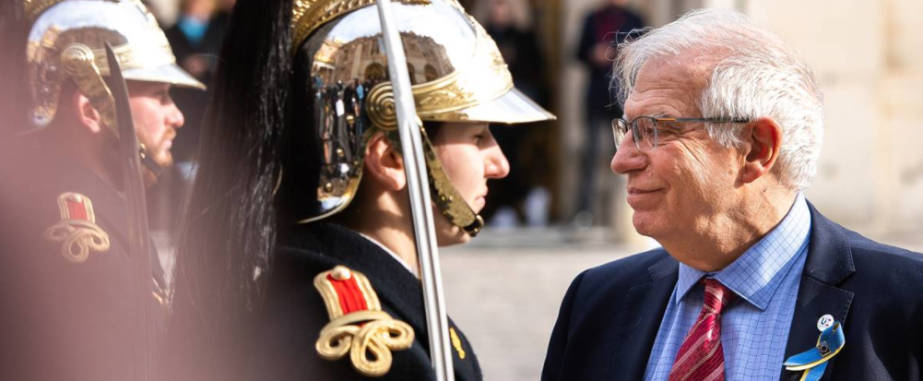
Strasbourg 13.03.2022 Anna van Densky The West made a mistake by promising Ukraine NATO membership, the EU top diplomat Josep Borrell said in an interview with LCI TV channel, France.

“There are moments in which we could have reacted better. For example, we proposed things that we could not guarantee, in particular Ukraine’s accession to NATO. This was never realised. I think it was a mistake to make promises that we could not fulfil,” the diplomat explained.

The head of European diplomacy also admitted that the West had made mistakes when building relations with Russia. “Thus, we lost the opportunity to bring Russia closer to the West in order to deter it,” Borrell continued.

Interviewed in Versailles just before the opening of the Summit of the 27, Josep Borrell said he believed that “Russia is bombarding indiscriminately”. According to him, “Mariupol is undoubtedly a war crime, but it’s not just that hospital. Russia is incapable of taking the cities, the Ukrainian resistance is very strong, so it is doing as it did in Syria or Chechnya, it bombs. The Russian army is an artillery army. So it bombs, it bombs, indiscriminately, sometimes a hospital, sometimes a pavement of a house.”

On February 24 President Vladimir Putin announced a special Russian military operation in response to a request for help from the heads of the Donbass self-proclaimed Republics. The head of state has pointed out that Moscow had no plans of occupying Ukrainian territories, but aims to “de-militarise and de-nazify” the neighbour. Later he added that one of Moscow’s key demands was that Ukraine remain neutral, and rejected plans to join NATO. As Director of the Russian Foreign Intelligence Service Sergey Naryshkin had earlier confirmed, it is critical for Russia because it is the “minimum territorial barrier” the country needs to preserve the existing security system.